Understanding UK Heat Pump Regulations and Installation Standards
A neutral guide to MCS standards, heat pump efficiency metrics, and regulatory requirements for UK households considering clean heating.
- Written by
- Net Zero Home Scheme editorial team
- Last updated
- Topic
- heat pumps, mcs standards, home energy
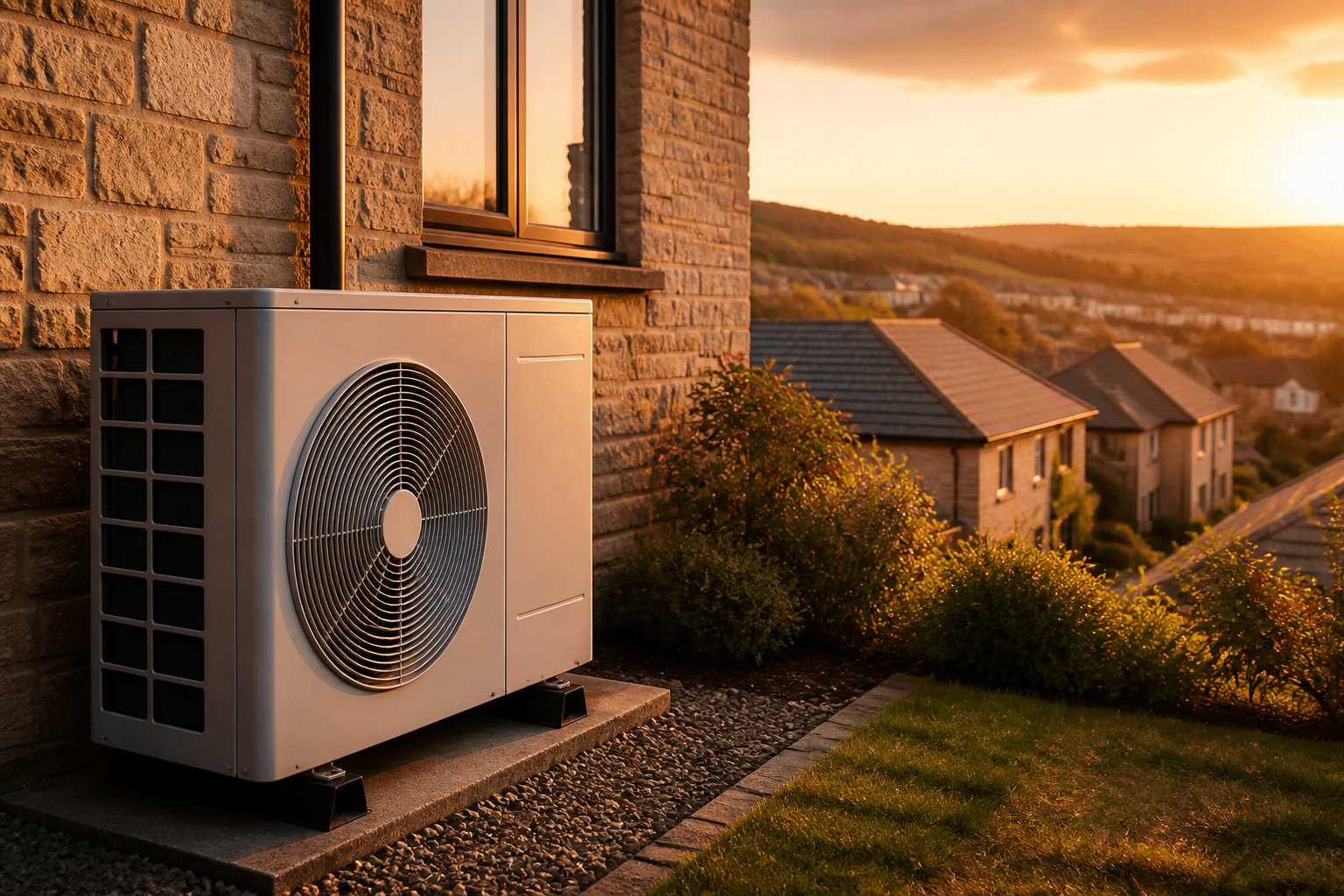
Replacing a fossil fuel heating system with an air source or ground source heat pump involves navigating a distinct set of UK regulatory frameworks, technical standards, and installation requirements. As Great Britain moves to reduce domestic emissions, energy policy established under the Climate Change Act requires a steady transition toward low-carbon space heating. According to the Climate Change Committee, residential heating accounts for approximately 14% of total UK greenhouse gas emissions, making home energy efficiency a central focus of long-term climate targets.
Understanding the regulatory structure governing heat pump installations helps property owners evaluate their options clearly. Standards set by the Microgeneration Certification Scheme (MCS), TrustMark, and local building control regulations govern technical parameters ranging from acoustic limits to room-by-room thermal calculations.
How heat pump standards are regulated in Great Britain
Heat pump installations in England, Scotland, and Wales are overseen by several certification bodies and consumer protection codes designed to maintain technical quality and safeguard property owners. The primary quality framework for small-scale renewable installations across the UK is the Microgeneration Certification Scheme (MCS).
An MCS certificate confirms that a heating system has been calculated, specified, and fitted to recognised technical standards. The certification covers both installer competence and product performance. For an installation to qualify for government grants or regional funding schemes, the work must be carried out by an MCS-accredited installer using certified equipment.
Consumer protection is reinforced by mandatory membership in approved consumer codes, such as the Renewable Energy Consumer Code (RECC) or the Home Insulation and Energy Systems Quality Assured Contractors Scheme (HIES). Installers registered with these codes must adhere to rules regarding clear pre-sale information, protected deposits, and access to independent dispute resolution. Furthermore, certified contractors frequently operate under TrustMark, the government-endorsed quality scheme for domestic property improvements.
Understanding SCOP and heat pump efficiency metrics
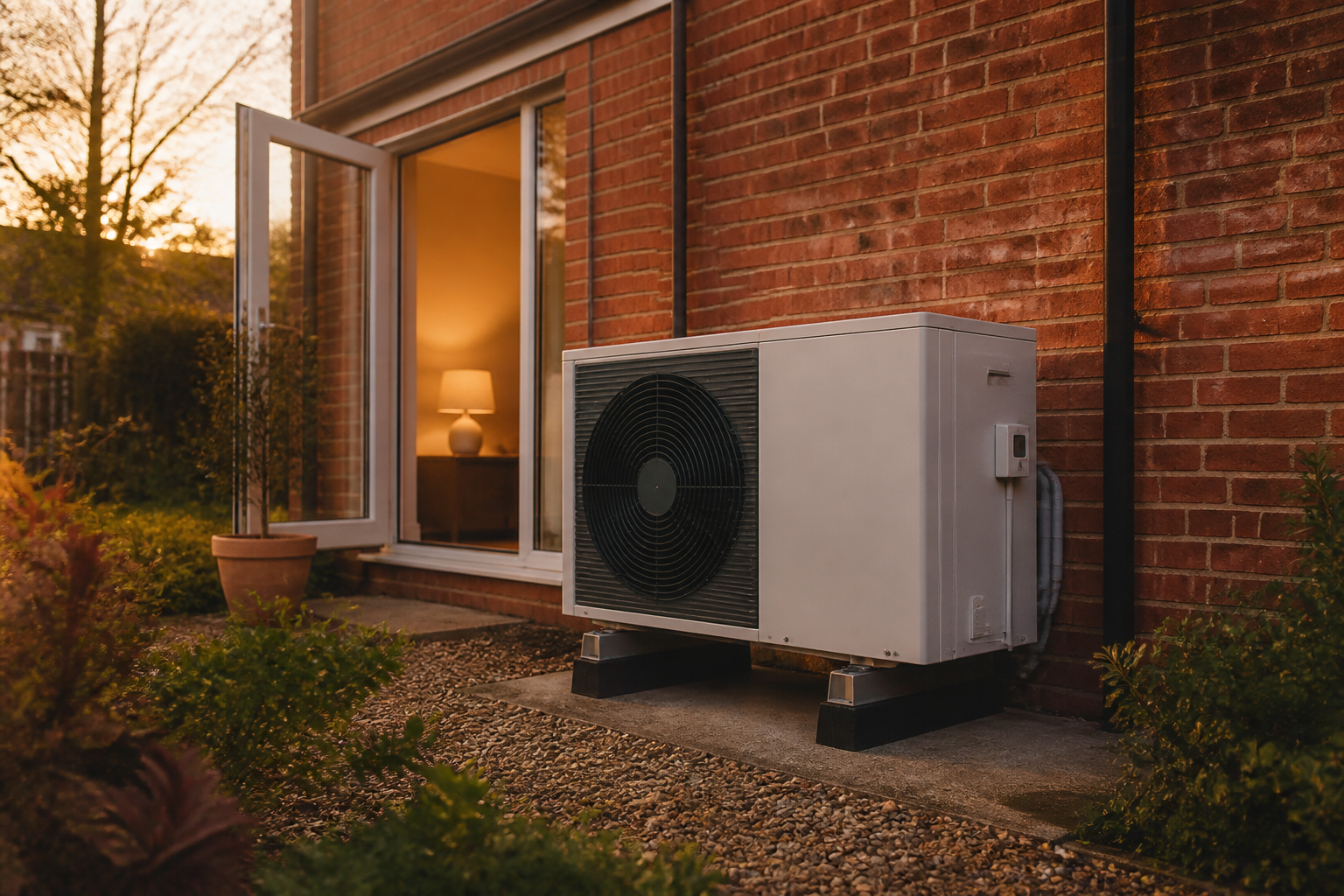
Evaluating heat pump performance requires an understanding of efficiency metrics, principally the Coefficient of Performance (COP) and the Seasonal Coefficient of Performance (SCOP).
The COP measures the instantaneous efficiency of a heat pump at a specific test point. A COP of 3.0 indicates that for every 1 kilowatt-hour (kWh) of electricity consumed, the unit generates 3 kWh of heat energy. However, outdoor temperatures fluctuate significantly throughout a British winter, directly affecting heating performance.
To provide a realistic measure of performance over a full year, the heating industry uses the SCOP rating. According to technical guidance published by the Energy Saving Trust, a modern air source heat pump typically operates with a SCOP between 3.0 and 4.0 in a well-designed UK home. Ground source heat pumps often achieve higher SCOP values, ranging between 3.5 and 4.5, due to stable underground temperatures throughout the winter months.
System efficiency is closely linked to flow temperature, which is the temperature of the water delivered to the home's radiators or underfloor heating loops. Lower flow temperatures produce higher SCOP figures. Designing a system to run at a flow temperature of 35°C to 45°C yields substantially better annual efficiency than running the system at 60°C or 65°C.
Planning permission and building regulations
In most domestic settings across England, air source heat pumps are designated as Permitted Development, meaning formal planning permission is not required provided specific statutory criteria are met. Under current general permitted development rules, requirements include:
- Compliance with the MCS 020 sound standard, restricting noise levels to a maximum of 42 decibels (dB(A)) measured at the nearest neighbouring property's window or door.
- The outdoor compressor unit must not exceed a volume of 0.6 cubic metres.
- The unit must be sited to minimise its visual impact and placed at an appropriate distance from property boundaries as specified by local planning codes.
- Only one air source heat pump may be installed on the property under Permitted Development rights.
Separate planning guidelines apply in Scotland and Wales, as well as for conservation areas or listed buildings where full planning consent is typically required.
In addition to planning limits, heat pump installations must comply with national Building Regulations. In England and Wales, Part L covers energy efficiency and pipework insulation, while Part P governs electrical safety to ensure the electrical supply and consumer unit can safely handle the compressor load.
Technical standards checklist for domestic heat pump installations
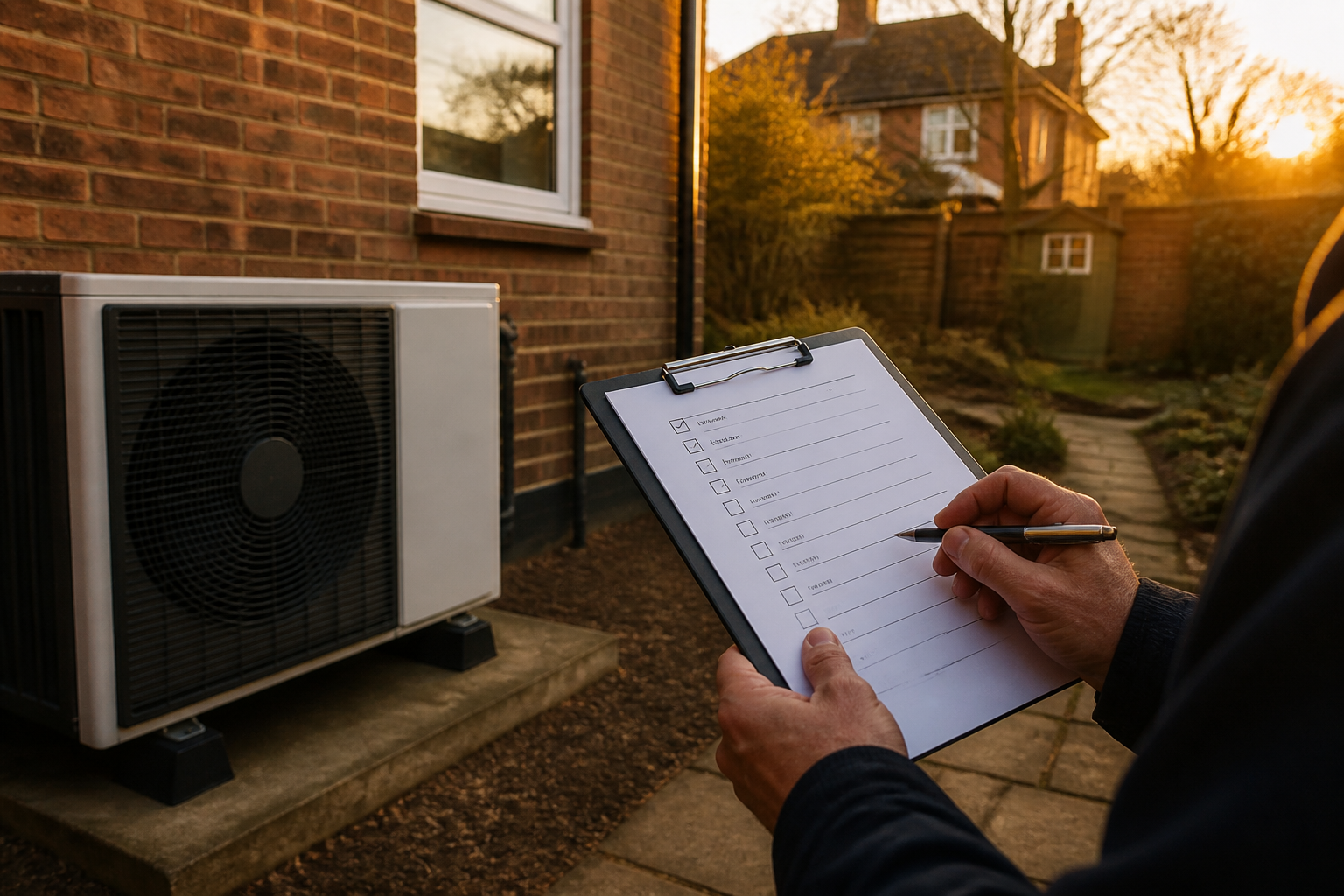
Before physical installation begins, an accredited installer completes technical assessments to verify system sizing and electrical safety.
| Assessment Stage | Required Standard | Operational Purpose |
|---|---|---|
| Room-by-room heat loss calculation | BS EN 12831 / MCS MIS 3005 | Calculates exact heat demand in kW for every room based on local design temperatures. |
| Emitter sizing evaluation | MCS MIS 3005-D | Evaluates whether existing radiators can deliver adequate heat at lower flow temperatures. |
| Acoustic boundary assessment | MCS 020 Standard | Calculates sound attenuation to ensure boundary noise remains below the 42 dB(A) limit. |
| Electrical grid connection | ENA G98 / G99 Notification | Notifies or seeks prior approval from the local Distribution Network Operator (DNO). |
| Commissioning and handover | MCS Compliance Certificate | Provides official documentation, performance estimates, and handover records. |
What this means for you
For UK householders considering a transition to clean heating, understanding these regulations helps set realistic expectations regarding preparation, installation timelines, and system choices.
Installing a heat pump is rarely a direct swap for a traditional gas boiler. Because heat pumps operate most efficiently at lower flow temperatures over sustained periods, installers may recommend upgrading select radiators to larger double-panel models or installing underfloor heating in high-demand living areas.
Practical steps to take during the planning process include:
- Requesting a comprehensive room-by-room heat loss calculation rather than a generic estimate based on overall house area.
- Verifying that the installer holds current MCS certification and is registered with an approved consumer code such as RECC or HIES.
- Confirming that the required DNO electrical notification or application has been submitted prior to starting work.
- Reviewing the acoustic assessment to ensure the outdoor unit location complies with MCS 020 limits relative to neighbouring properties.
Typical installation timescales range from two to five days for a straightforward air source heat pump retrofit. Complex ground source systems or projects requiring extensive radiator upgrades may take longer.
For organisations seeking to help employees navigate home energy decisions, the Net Zero Home Scheme offers access to member pricing on heat pumps, solar panels, and battery storage installed by accredited contractors across England, Scotland, and Wales, with no salary sacrifice and no payroll deduction required.
Frequently asked questions
Do all heat pumps require an MCS certificate?
An MCS certificate is not a strict legal requirement to physically install a heat pump, but it is necessary to access government grants, export tariffs, and simplified building control compliance. Using an MCS-certified installer ensures that the system meets established quality, safety, and performance criteria.
How does flow temperature affect heat pump performance?
Flow temperature refers to the temperature of the water circulating through radiators or underfloor heating. Heat pumps achieve their highest efficiency when supplying water at lower temperatures, such as 35°C to 45°C. Raising the flow temperature to 60°C or above reduces the Seasonal Coefficient of Performance (SCOP), consuming more electricity for the same heat output.
Will a heat pump work with existing radiators?
A heat pump can work with existing radiators if those radiators possess sufficient surface area to heat the property at lower flow temperatures. During the initial design survey, an installer calculates the heat requirements for each room to determine whether existing emitters are suitable or if specific radiators need upgrading.
Sources
- Microgeneration Certification Scheme Standards, MCS
- In-depth guide to heat pumps, Energy Saving Trust
- UK Buildings and Heat Strategy, Department for Energy Security and Net Zero