Guide to Solar Microinverters and DC Optimisers
Learn how solar microinverters and DC optimisers work, what they cost in the UK, when panel-level optimisation is worth it and what to ask your installer.
- Written by
- Net Zero Home Scheme editorial team
- Last updated
- Topic
- solar, energy efficiency, mcs
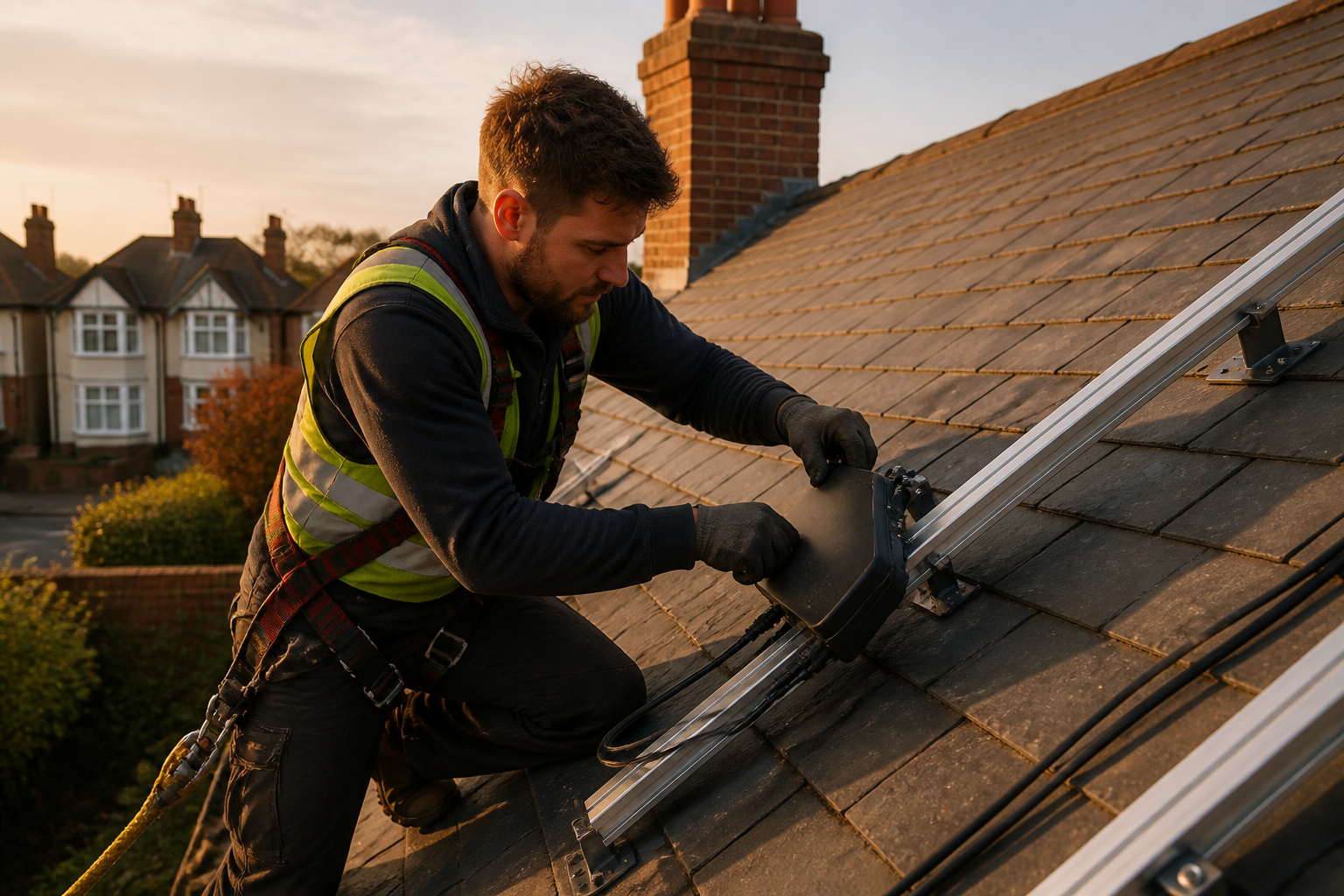
When installing home solar photovoltaics (PV), choosing the right inverter architecture is one of the most important technical decisions you will make. While traditional solar installations connect multiple panels together in a series string to a single central inverter, modern installations increasingly use module-level power electronics. These technologies, which comprise direct current (DC) power optimisers and microinverters, manage power generation at individual panel level rather than across an entire array.
Understanding how panel-level electronics work, what they cost, and when they are necessary helps ensure you do not overspend on hardware you do not need, or conversely, miss out on significant generation potential on a complex roof.
How do microinverters and DC optimisers work?
In a standard string inverter setup, solar panels are wired together like lights on a string. Electric current flows through each panel in sequence before reaching a central inverter, which converts the direct current (DC) produced by the panels into alternating current (AC) used by your home appliances. Because the panels are connected in series, the output of the entire string is governed by its lowest-performing panel. If a single panel is shaded by a chimney, overcast by tree branches, or dirty, the current flowing through every other panel in that string drops to match that single panel.
Module-level power electronics solve this limitation using two different technical approaches:
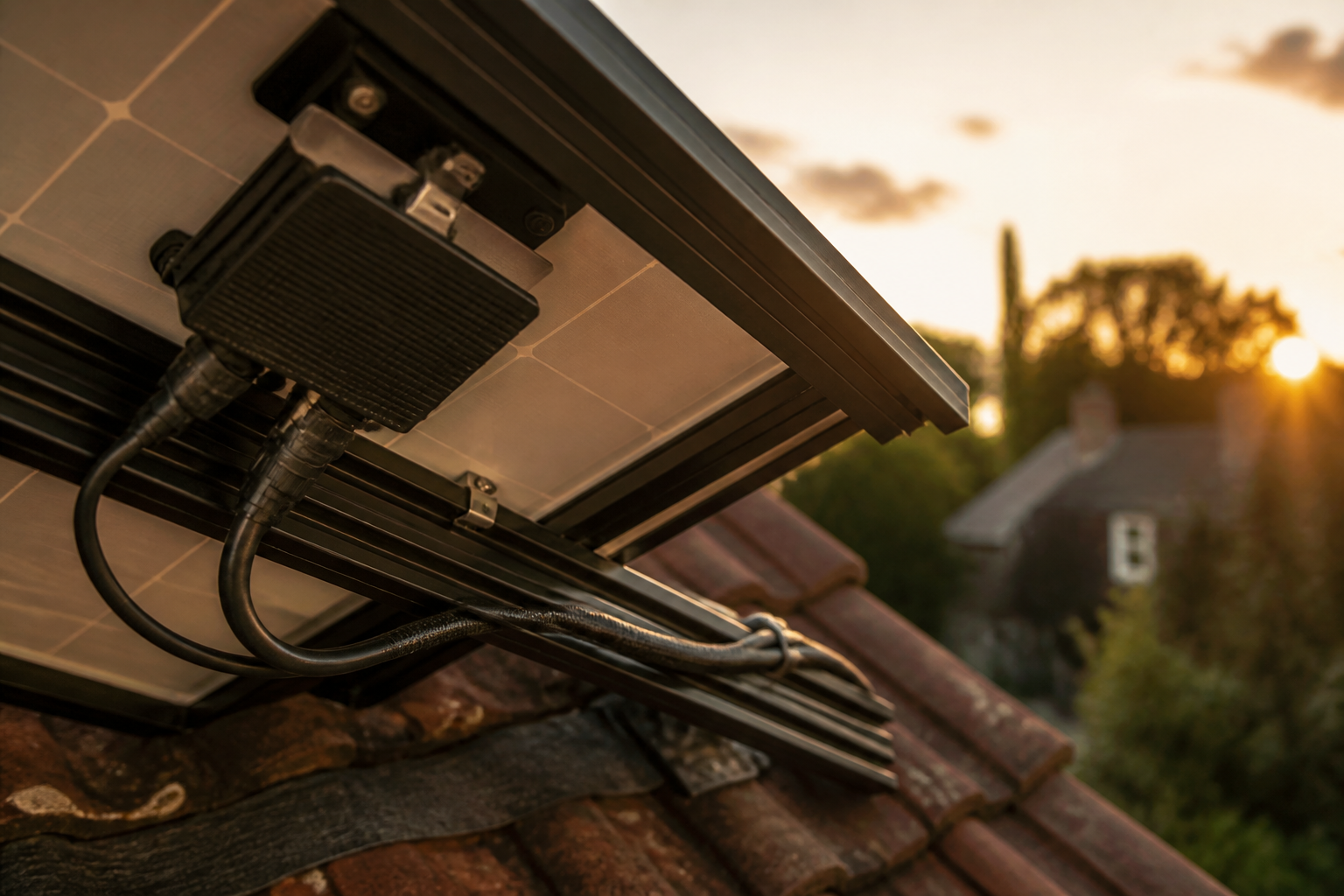
- DC Power Optimisers: Fixed behind each individual solar panel, power optimisers are small electronic devices that perform maximum power point tracking (MPPT) at panel level. The optimisers adjust the voltage and current output of each panel before passing DC electricity along the string to a central inverter. If one panel is shaded, its optimiser adjusts output to maintain optimal current, allowing unshaded panels to continue operating at full capacity.
- Microinverters: Instead of modifying DC power and sending it to a central inverter on the wall, a microinverter is a compact AC inverter installed directly beneath each solar panel. It converts DC power to AC power right on the roof. Each panel acts as an independent power generator. If one panel is obscured or develops a fault, none of the other panels on the roof are affected.
According to technical guidance published by the Energy Saving Trust, panel-level power electronics can recover between 5 percent and 25 percent of system generation that would otherwise be lost to shading or complex roof orientations.
When is panel-level optimisation worth the investment?
Module-level electronics add hardware components and complexity to your roof, so they are not necessary for every home. Evaluating your property layout helps determine whether the technology is a practical investment.
Panel-level electronics are recommended in the following scenarios:
- Partial shading: Your roof experiences temporary or permanent shadows from trees, dormer windows, telegraph poles, or neighbouring properties during daylight hours.
- Multiple roof angles and orientations: Your solar array is split across different roof faces, such as an east-west split or a mix of main roof and garage installation, where panels receive varying levels of sunlight throughout the day.
- Granular system monitoring: You want to track the real-time electrical output, degradation, and health of each panel individually through a mobile app or web interface.
- Enhanced safety features: Microinverters and optimisers automatically reduce roof-level DC voltage to safe levels (often 1 volt per panel) when the grid power shuts off or during maintenance, meeting stringent rapid shutdown safety guidelines.
Conversely, module-level electronics may be a poor fit or unnecessary extra expense if:
- Your roof is completely unshaded, faces south at a consistent tilt angle, and accommodates a single uniform array.
- You are working on a strict budget where the added upfront cost yields an unreasonably long payback period.
- You prefer a simpler system with fewer roof-mounted electronic components that could require physical access in the future.
What do solar optimisers and microinverters cost in the UK?
Adding panel-level power electronics increases total system costs due to the additional hardware and the extra labor required during panel assembly.
| System Type | Typical Installed Cost (4kW System) | Central Inverter Lifespan | Typical Hardware Warranty |
|---|---|---|---|
| Standard String Inverter | £6,000 - £7,500 | 10 - 12 years | 5 - 10 years |
| System with DC Optimisers | £6,400 - £8,300 | 10 - 12 years | 25 years (optimisers) |
| System with Microinverters | £6,800 - £9,000 | N/A (no central unit) | 25 years (microinverters) |
According to figures from the Energy Saving Trust, a standard 4kW solar array costs around £6,000 to £7,500 including installation. Adding DC optimisers typically adds £400 to £800 to the total bill. Choosing full microinverters typically adds £800 to £1,500 over a basic string inverter configuration.
While microinverters carry a higher upfront cost, they remove the central string inverter from the system. Central string inverters frequently require replacement after 10 to 12 years at a cost of £800 to £1,500 including installer labor, whereas microinverters are rated for a 25-year service life that matches the operational life of the solar panels themselves.
What accreditations and electrical standards apply?
To ensure safety, performance, and eligibility for export tariffs, your installer and equipment must comply with recognised UK industry standards:
- MCS Accreditation: The Microgeneration Certification Scheme (MCS) certifies both the equipment and the installer. You must have an MCS certificate to register for the Smart Export Guarantee (SEG), which pays you for excess solar electricity exported to the National Grid.
- TrustMark Registration: Installers should be registered with TrustMark, the government-endorsed quality scheme for home improvements, which provides consumer protection and clear dispute resolution channels.
- Consumer Code Membership: Your installer must belong to a consumer code approved by the Chartered Trading Standards Institute, such as the Renewable Energy Consumer Code (RECC) or the Home Insulation and Energy Systems Contractors Scheme (HIES).
- DNO Notification and Approval: Your installation must comply with Energy Networks Association guidelines. Systems with an inverter capacity up to 3.68kW per phase fall under G98 rules, requiring simple notification within 28 days of commissioning. Larger capacity systems require prior grid approval under G99 rules before installation begins.
- Electrical Competency: All AC electrical work must comply with BS 7671 wiring regulations and be carried out by a competent electrician registered with an organisation such as NICEIC or NAPIT.
What should you ask your solar installer?
Before signing a contract for an array featuring optimisers or microinverters, ask your installer the following questions:
- What does your shading analysis software predict my annual kilowatt-hour yield will be with a standard string inverter compared to an optimised or microinverter system?
- Does your quote include 25-year manufacturer warranties for all microinverters or optimisers, and does the installer warranty cover roof-access labor costs if a unit needs replacement?
- How will this inverter setup affect my options for adding battery storage, an EV charger, or a hot water diverter now or in the future?
- Will the microinverter or optimiser system require a dedicated gateway or internet bridge to enable panel-level monitoring and warranty tracking?
What is the realistic installation timeline?
From your initial query to generating clean electricity, a solar installation using panel-level electronics typically spans four to eight weeks.
| Stage | Activity | Key Deliverables | Typical Duration |
|---|---|---|---|
| Stage 1 | Initial Survey & Design | Roof structural check, shading analysis, formal quotation | 1 - 2 weeks |
| Stage 2 | Grid Approval (if required) | G99 application submitted to DNO for larger inverters | 2 - 4 weeks |
| Stage 3 | Scaffolding & Logistics | Delivery of panels, microinverters/optimisers, scaffolding setup | 1 - 2 days |
| Stage 4 | On-Site Installation | Roof mounting, microinverter fixing, panel wiring, AC connection | 1 - 2 days |
| Stage 5 | Commissioning & Handover | System testing, gateway setup, MCS registration, DNO notification | 1 - 2 weeks |
What this means for you
If your roof faces a single direction with zero shading from nearby structures, a traditional string inverter remains the most straightforward and cost-effective choice. However, if your property features multiple roof pitches, dormers, or partial shade from trees, investing in DC power optimisers or microinverters protects your generation yield and prevents single-panel shading from suppressing the output of your whole array.
When planning home energy upgrades alongside employment benefits, the Net Zero Home Scheme provides UK employees with transparent, member-rate access to accredited solar PV, battery storage, and heat pump installations, with no salary sacrifice or payroll deductions required.
Frequently asked questions
Do microinverters last longer than central string inverters?
Yes. Central string inverters operate under high electrical stress and typically require replacement after 10 to 12 years. Microinverters are sealed units designed for harsh roof conditions and generally carry 25-year manufacturer warranties, matching the expected life of the solar panels.
Can I connect a home battery to a microinverter system?
Yes. Microinverters output standard AC electricity on the roof, which flows directly into your consumer unit. You can pair a microinverter solar system with an AC-coupled battery system. AC-coupled batteries store excess power directly from your home AC wiring, regardless of how the solar power was generated.
Do optimisers or microinverters produce electricity in total shade?
No. Panel-level electronics cannot generate power without sunlight. What they do is isolate the shaded panel so its reduced output does not restrict the electrical current passing through the unshaded panels in the rest of your array.
Sources
- Solar panels guide, Energy Saving Trust
- MCS Installation Standards, Microgeneration Certification Scheme
- Smart Export Guarantee (SEG), Ofgem