Great Britain Solar Panel Installations Reach 15-Year High
Domestic solar panel installations in Great Britain have hit a 15-year high. Here is what the data shows for costs, grid capacity and household energy bills.
- Written by
- Net Zero Home Scheme editorial team
- Last updated
- Topic
- solar, energy efficiency, energy bills
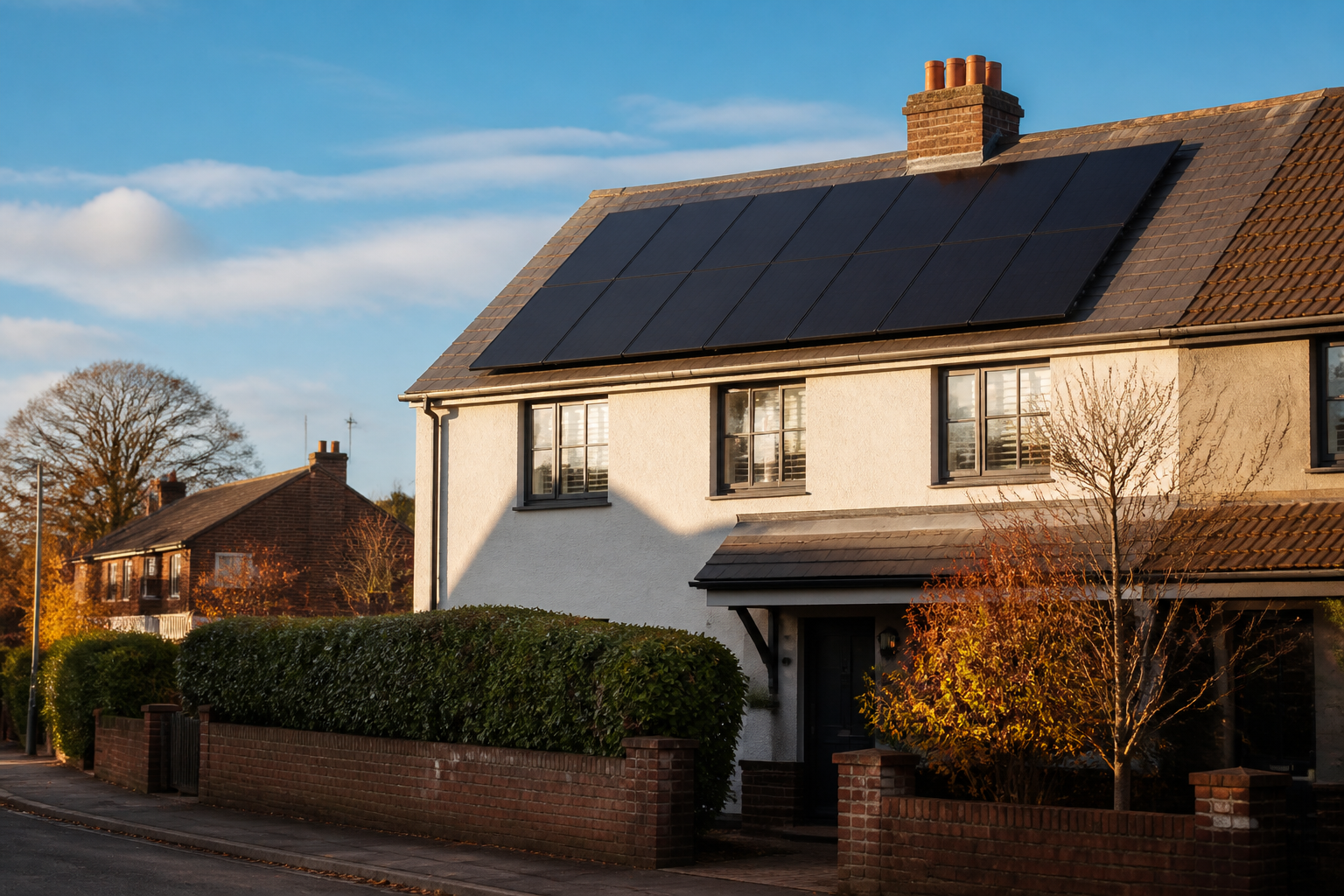
Rooftop solar photovoltaic installations across Great Britain have reached their highest volume in 15 years, driven by volatile grid electricity tariffs and reduced equipment hardware costs. According to data reported by The Guardian on 31 July 2026, certified residential solar installations have surged as householders seek to lock in long-term electricity generation directly on their properties.
Further analysis published by Energy Saving Trust on 24 July 2026 and reporting from The Independent on 3 August 2026 indicate that a combination of zero-rate VAT on energy-saving materials and stabilizing supply chains has improved installation economics. However, as rooftop capacity grows, questions around distribution network capacity, Distribution Network Operator approvals, and export tariff structures are coming to the fore.
Here is an operational analysis of what these latest figures mean, what drives current installation economics, and what you need to consider before adding rooftop solar to your home.
What is driving the record adoption of home solar?
The primary catalyst for the current deployment rate is the retail price of grid electricity. Under Ofgem price caps and market pricing structures in 2026, standard variable electricity rates remain significantly higher than pre-2021 historical baselines, averaging around 24.5p per kilowatt-hour (kWh) depending on your region and payment method.
At the same time, the turnkey cost of installing residential solar PV has adjusted. According to industry metrics compiled under Microgeneration Certification Scheme (MCS) data, an average 4.0 kilowatt-peak (kWp) system on a standard pitched roof costs between £6,000 and £8,000 including installation, scaffolding, and electrical commissioning. When paired with a zero percent VAT rate on domestic energy storage and renewables, the initial capital outlay is lower in real terms than during previous market peaks.
Because an appropriately sized 4.0 kWp array in central England generates approximately 3,400 kWh to 3,800 kWh of electricity per year, a household that consumes a large portion of that energy directly can reduce its annual grid purchases considerably. The exact financial return depends heavily on your daytime usage patterns, roof orientation, pitch, and whether battery storage is installed to capture surplus generation.
Grid approval rules and export considerations
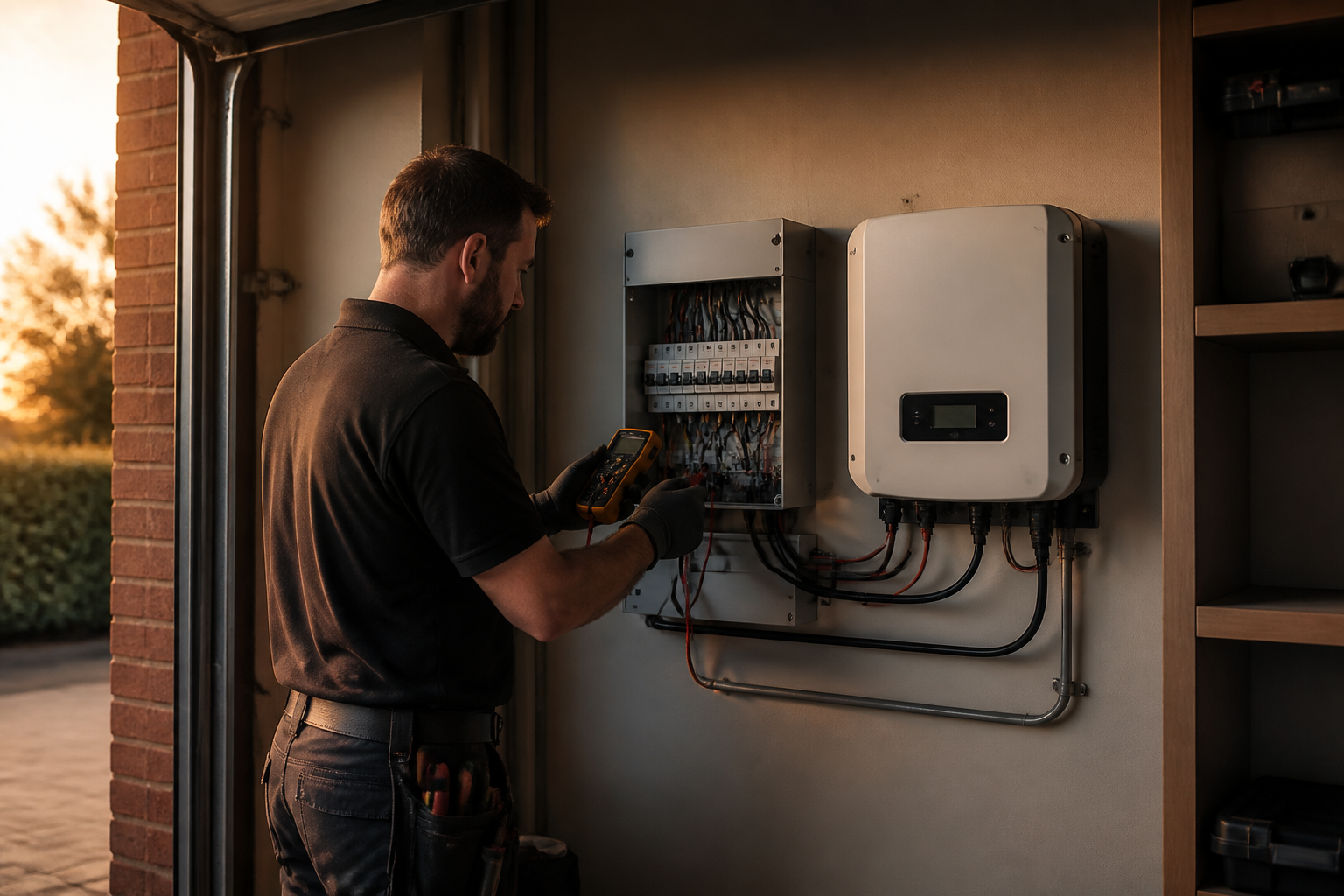
As rooftop solar density increases across low-voltage local networks, regulatory compliance and grid connections have become critical installation steps. Every grid-tied solar system in England, Scotland, and Wales must strictly adhere to Energy Networks Association standards overseen by your local Distribution Network Operator (DNO).
For standard domestic installations, two main connection pathways exist:
- G98 notification: Applies to systems where the maximum AC output from the inverter does not exceed 3.68 kilowatts (kW) on a single-phase electricity supply (or 11.04 kW on a three-phase supply). Under G98, your installer connects the system and notifies the DNO within 28 days of commissioning.
- G99 application: Required if the inverter output exceeds 3.68 kW on a single-phase supply, or if multiple generation sources (such as a large solar array combined with a high-output battery inverter) are combined. A G99 requires formal approval from the DNO prior to installation, which can take anywhere from two to eight weeks depending on network capacity.
As highlighted in analysis published by The Telegraph on 22 July 2026 regarding global export management trends, grid operators are increasingly evaluating local network loading. If a neighborhood circuit experiences high local voltage levels during peak daylight hours, the DNO may grant G99 approval only on the condition that inverter export limits are applied.
Export tariff choices also dictate financial performance. Under the Smart Export Guarantee (SEG), licensed energy suppliers must offer householders payment for electricity exported back to the grid. SEG rates vary widely across suppliers, currently spanning from around 3p/kWh on standard baseline tariffs to over 15p/kWh on fixed or dynamic export plans that require a compatible smart meter.
System configuration comparison
The table below outlines typical system configurations, estimated generation ranges, hardware cost expectations, and DNO notification requirements for standard UK residential properties.
| System Size (kWp) | Estimated Annual Generation | Typical Cost Installed (Excl. Battery) | DNO Process | Key Operational Detail |
|---|---|---|---|---|
| 2.5 kWp Array | 2,100 to 2,400 kWh | £4,500 to £5,500 | G98 Notification | Best suited for smaller roofs or terraced homes with lower daytime demand |
| 4.0 kWp Array | 3,400 to 3,800 kWh | £6,000 to £8,000 | G98 Notification | Standard size for semi-detached and detached homes using a 3.68 kW AC inverter |
| 6.0 kWp Array | 5,100 to 5,700 kWh | £8,500 to £11,000 | G99 Prior Approval | Recommended for larger properties, heat pump users, or EV owners; requires DNO sign-off |
| 8.0 kWp Array | 6,800 to 7,600 kWh | £11,000 to £14,000 | G99 Prior Approval | High generation capacity; often requires export curtailment controls or three-phase supply |
What this means for you
If you are evaluating solar PV for your property during this period of high adoption, project success relies on robust technical planning rather than relying on generalized payback estimates.
First, assess your roof geometry and shading profile. A south-facing roof tilted at 30 to 35 degrees delivers maximum annual yield, but east-west configurations are increasingly popular because they distribute electricity generation across morning and late afternoon hours, matching household routine usage more closely.
Second, check installer accreditations. To secure SEG export payments and guarantee compliance with building regulations, your system must be installed by an MCS-certified contractor who is a member of an approved consumer code, such as the Renewable Energy Consumer Code (RECC) or the Home Insulation and Energy Systems Quality Assured Contractors Scheme (HIES). Electrical wiring must comply with BS 7671 standards, and certified by an electrician registered with a body such as NICEIC or NAPIT.
Third, review your domestic electrical infrastructure. If your property still uses an older fuse box, a consumer unit upgrade incorporating Type A Residual Current Devices (RCDs) and surge protection devices may be necessary to safely support the solar inverter. For employees looking to access installer networks and competitive pricing, the Net Zero Home Scheme offers member pricing on solar and battery storage systems delivered alongside accredited installers across England, Scotland, and Wales.
Finally, model your economics on self-consumption rather than export revenue alone. Using solar power directly to offset 24.5p/kWh grid purchases yields greater financial return than exporting power for a lower SEG rate, making device scheduling and optional battery buffering key elements of system design.
Frequently asked questions
Do you need planning permission for rooftop solar panels in Great Britain?
In most cases across England, Scotland, and Wales, installing solar PV on a residential roof falls under Permitted Development rights. However, the panels must not project more than 200 millimetres beyond the plane of the roof slope, and must not be higher than the highest part of the roof. Planning permission is required if your property is a listed building, situated within a conservation area with restricted permitted development rights, or if panels are mounted on a wall facing a highway.
How long does it take for a solar panel installation to pay for itself?
Payback periods typically range between seven and eleven years for a standard 4.0 kWp array without battery storage, depending on roof orientation, local solar irradiance, and your self-consumption rate. Adding battery storage increases initial equipment costs by £2,500 to £5,000, which can extend the absolute capital payback timeframe, but improves self-consumption rates from around 30 percent up to 70 percent or higher.
What happens if your Distribution Network Operator restricts your solar export?
Sources
- New solar panels in Great Britain at 15-year high as fossil fuel costs soar, The Guardian
- Plug-in solar panels and the rooftop revolution, Energy Saving Trust
- Why 2026 could be the right time to buy solar panels, independent.co.uk
- Australia’s ‘sun tax’ warning for Britain’s solar panel owners, The Telegraph