Hydronic Balancing: Physics, System Efficiency and Comfort
Hydronic balancing ensures water flows evenly through radiators, lowering return temperatures to boost heat pump COP and boiler efficiency across UK homes.
- Written by
- Net Zero Home Scheme editorial team
- Last updated
- Topic
- heat pumps, energy efficiency, home energy
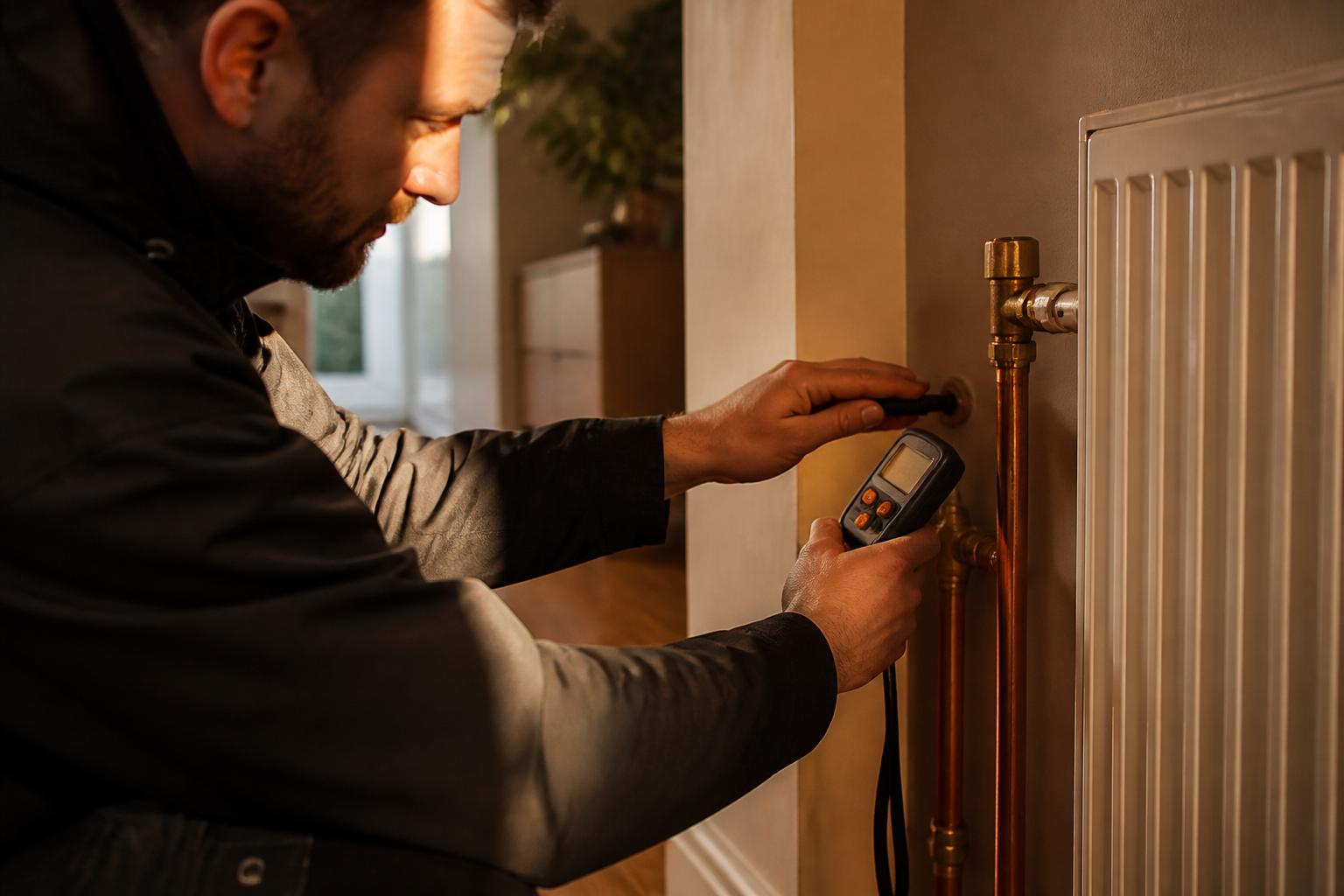
In any wet central heating system, water takes the path of least resistance. Without proper calibration, hot water naturally rushes through the shortest, widest pipe circuits, typically the radiators closest to the boiler or heat pump. Meanwhile, radiators situated farther along the pipework network receive insufficient flow, leaving rooms cold and slow to heat.
Hydronic balancing is the process of adjusting water flow rates across every emitter circuit in a home so that each room receives precisely the thermal output it was designed to deliver. While often overlooked during routine boiler swaps or radiator upgrades, hydronic balancing is fundamental to thermal comfort, energy conservation, and system longevity.
The Physics of Water Flow and Temperature Drop
The operation of a hydronic central heating system is governed by fluid dynamics and thermal transfer equations. The rate at which energy is delivered to a room depends directly on mass flow rate and the temperature difference between the water entering the radiator and the water leaving it. This difference is known as Delta T, expressed as $\Delta T$.
The relationship between heat transfer, flow rate, and temperature difference is defined by the thermal power equation:
Power (kW) = Mass Flow Rate (kg/s) \times Specific Heat Capacity of Water (4.187 kJ/kg\text{°}C) \times \Delta T (\text{°}C)
In traditional high-temperature gas boiler systems, pipework and radiators were sized for a wide Delta T, typically 20\text{°}C, with a flow temperature of 75\text{°}C and a return temperature of 55\text{°}C. Modern low-temperature heat generators, such as air source heat pumps, operate most efficiently at much narrower Delta T values, usually between 5\text{°}C and 8\text{°}C, with flow temperatures around 45\text{°}C or lower.
Hydraulic resistance within a pipe network increases with the square of the flow velocity. If a radiator valve is fully open near the heat source, the local hydraulic resistance is low, resulting in excessive water velocity through that individual emitter. Water passes through the radiator so quickly that it does not have enough time to transfer its heat into the room. Consequently, the water exits the radiator at nearly the same temperature at which it entered, returning elevated water temperatures back to the central heat generator.
How Hydronic Imbalance Affects System Efficiency
When high-temperature water returns directly to a heating generator, system performance drops significantly. According to the Chartered Institution of Building Services Engineers (CIBSE) Guide B1, poor hydronic distribution can reduce overall heating system operating efficiency by 10% to 15% through short-cycling and elevated return temperatures.
For modern condensing gas boilers, latent heat recovery depends entirely on flue gas moisture condensing against cooler return pipework. Condensation begins when return water temperatures fall below approximately 54\text{°}C. If an unbalanced network delivers return water at 58\text{°}C, the boiler cannot condense, forfeiting up to 11% in seasonal fuel efficiency.
For heat pumps, the impact is even more severe. A heat pump's Efficiency or Coefficient of Performance (COP) is governed by the Carnot cycle efficiency, which declines as the lift between evaporating and condensing temperatures expands. High return temperatures force the compressor to operate at higher condensing pressures, directly increasing electrical power consumption. Data from Energy Saving Trust heat pump field trials confirmed that maintaining designed system Delta T and eliminating bypass flow are vital to achieving seasonal performance factors above 3.0.
Manual Static Balancing vs Dynamic Balancing Valves
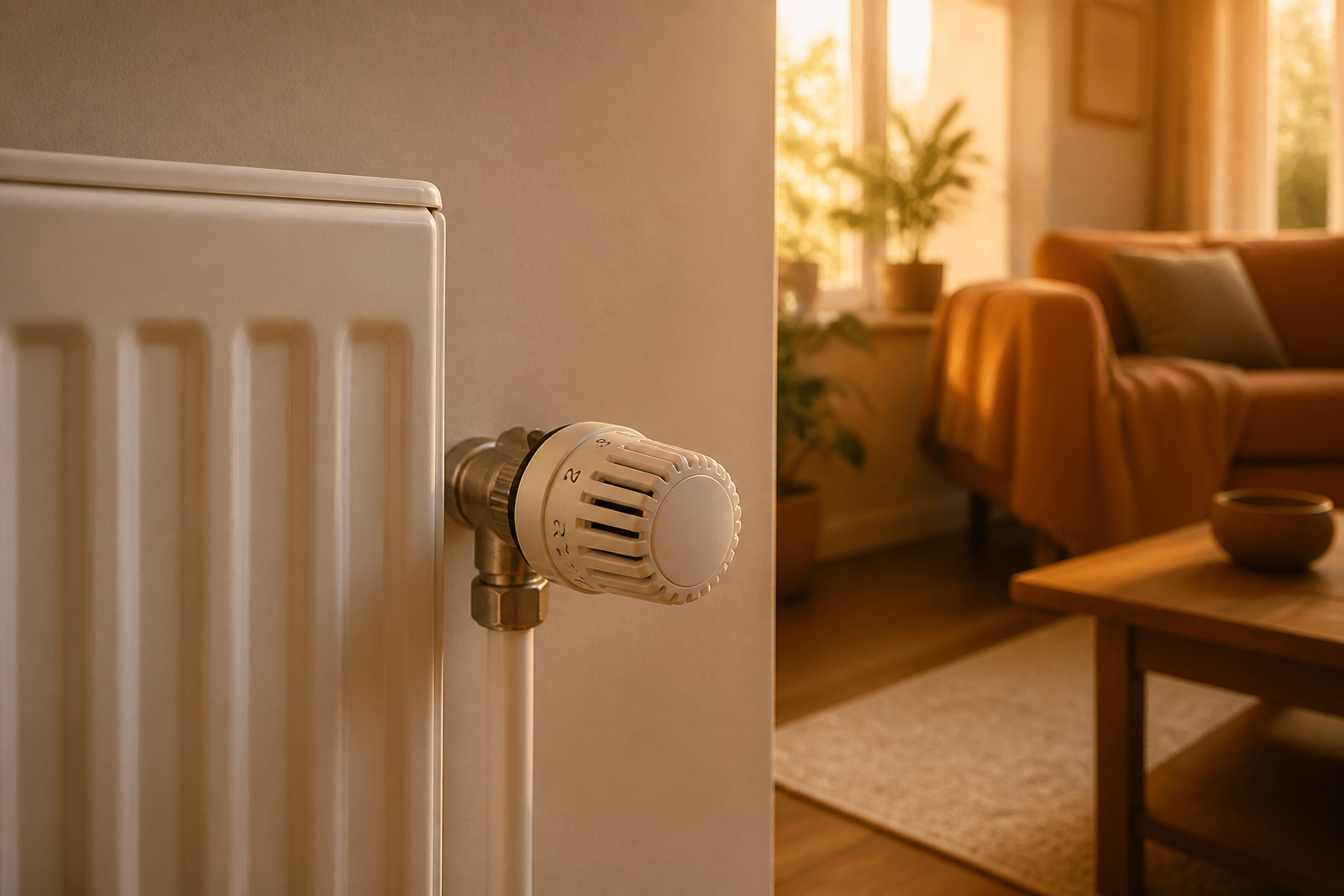
Historically, heating engineers performed manual static balancing using lockshield valves on the exit pipework of each radiator. The engineer restricts flow on near radiators to increase system pressure, forcing water toward distant rooms. However, static balancing only optimizes the network for a single static state, when every thermostatic radiator valve (TRV) is fully open.
Modern heating design relies increasingly on dynamic auto-balancing valves, also known as pressure-independent TRVs. These devices contain an integrated differential pressure controller that automatically maintains a constant targeted flow rate through each radiator, regardless of whether TRVs on other radiators in the house are opening or closing.
| Balancing Technique | Initial Equipment Cost | Installation Complexity | Flow Rate Stability | Best Suited For |
|---|---|---|---|---|
| Static Manual Balancing | Low (£0 added hardware) | High (requires manual temperature tuning) | Low (flow changes as TRVs modulate) | Older fixed-temperature gas boiler loops |
| Pre-settable TRVs | Low to Moderate (£10 to £20 per emitter) | Moderate (calculated Kv dial settings) | Moderate (fixed hydraulic resistance) | Standard wet heating retrofits |
| Dynamic Auto-Balancing Valves | Moderate (£15 to £30 per emitter) | Low to Moderate (direct l/min dial setting) | High (constant flow rate despite network changes) | Low-temperature heat pumps and condensing boilers |
Trade-offs, Costs and Practical Limitations
While the theoretical benefits of hydronic balancing are clear, implementing it involves real-world practical trade-offs:
- Labor time and expert cost: Manual static balancing requires measuring temperatures across every individual radiator pipe loop using surface contact thermocouples. This process can take two to four hours for a typical domestic property, adding to professional service charges.
- Hardware expenditure: Retrofitting dynamic auto-balancing TRVs across a ten-radiator property costs between £150 and £300 for valves alone, excluding installer labor.
- Pump differential pressure requirements: Restricting flow across multiple emitters increases circuit resistance. If an older circulation pump is set to a fixed high speed rather than a variable differential pressure mode, balancing can create audible flow noise across valve seats.
- System debris and magnetite: Fine valve orifices in pre-settable and dynamic TRVs are susceptible to blockage if magnetic sludge or limescale is present in central heating water. Comprehensive system flushing and fitting a magnetic filter are required prerequisites.
What this means for you
If your home has cold spots, noisy pipework, or radiators that heat up at wildly different speeds, your heating network is likely out of balance. Before investing in larger radiators or higher-capacity heat generators, resolving flow distribution is the most cost-effective first step.
When planning a heat pump installation or boiler upgrade, ensure your installer includes hydronic balancing as part of their formal commissioning scope. Under Building Regulations Part L, commissioned heating systems in England and Wales are required to be balanced to ensure energy performance standards are met.
Homeowners evaluating low-carbon heating can explore verified installations through the Net Zero Home Scheme, which provides access to accredited contractors adhering to MCS installation standards across England, Scotland, and Wales.
Frequently asked questions
Does hydronic balancing replace thermostatic radiator valves?
No. Thermostatic radiator valves (TRVs) respond to air temperature changes in individual rooms, closing as rooms warm up from solar gain or occupants. Hydronic balancing sets the maximum hydraulic water flow rate to each radiator so that when TRVs open, no single radiator starves the rest of the network.
Can you balance a central heating system as a DIY project?
You can perform basic static balancing using lockshield valves and contact thermometer probes attached to flow and return pipes on each radiator. However, accurately calculating required flow rates in litres per minute based on radiator heat loss calculations generally requires professional tools or pre-settable dynamic valves.
How do you identify an unbalanced central heating network?
Common indicators include radiators closest to the heat source becoming hot long before distant radiators, significant temperature variations between rooms despite identical TRV settings, or return pipes at the boiler feeling almost as hot as the flow pipes.
Sources
- CIBSE Guide B1: Heating, Chartered Institution of Building Services Engineers
- Domestic Heating Design Guide, Energy Saving Trust
- Conservation of fuel and power: Building Regulations Part L, HM Government