Understanding Heat Pump Modulation and Cycling Losses
Discover how heat pump inverter modulation and turndown ratios prevent short cycling, preserve SCOP efficiency, and lower winter running costs in UK homes.
- Written by
- Net Zero Home Scheme editorial team
- Last updated
- Topic
- heat pumps, energy efficiency, home energy
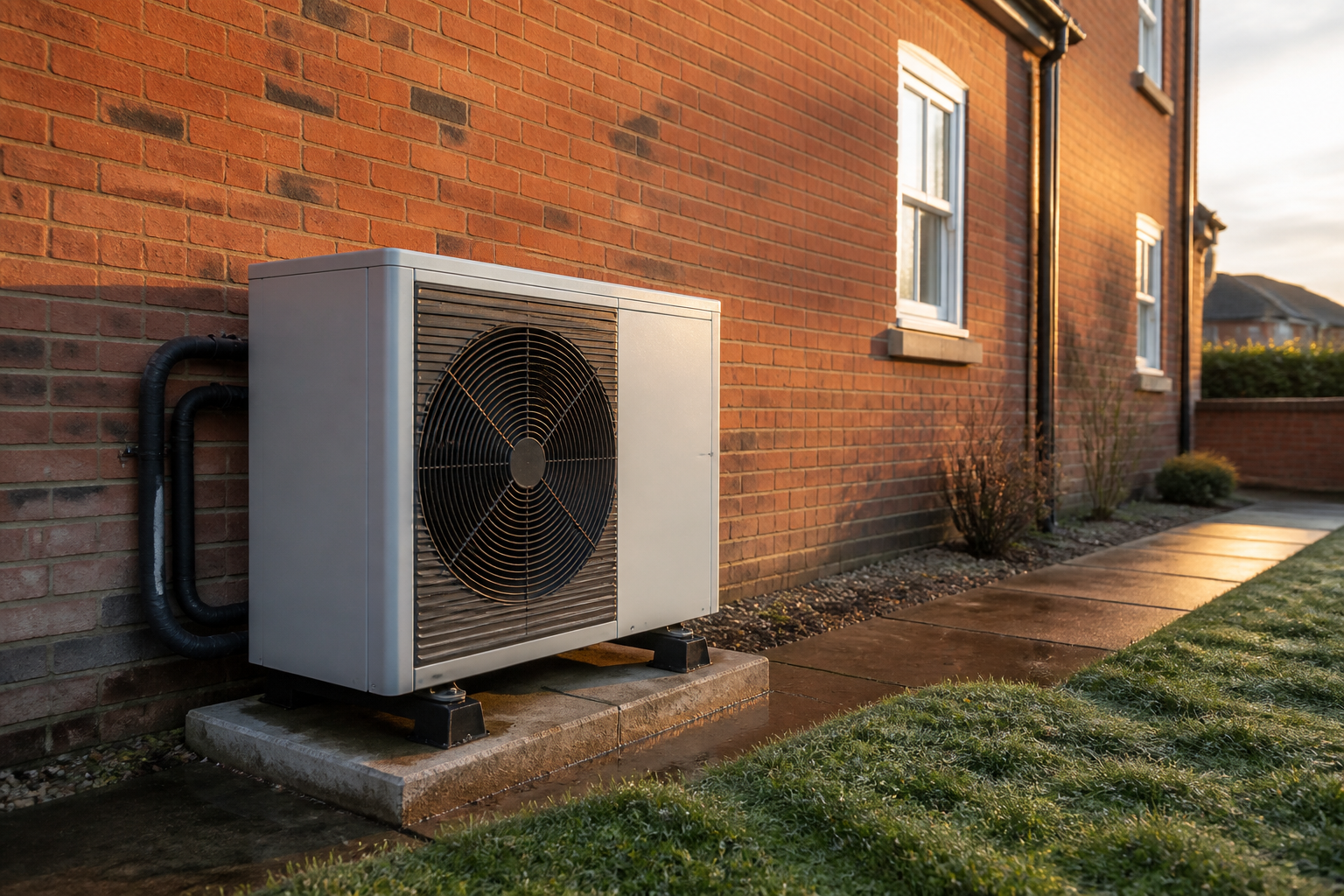
When replacing a fossil-fuel boiler with an air source heat pump, one of the most fundamental shifts in system operation is how heat output is controlled. Traditional gas boilers operate predominantly through intermittent firing, delivering high bursts of energy before shutting off. In contrast, modern heat pumps are engineered to run continuously for long periods at low output, matching the rate of home heat loss in real time. This capability relies on inverter modulation.
Understanding the physics behind compressor modulation, turndown ratios, and cycling losses explains why correct sizing and system design matter so much. A heat pump that modulates smoothly maintains high efficiency and steady room temperatures, while a system forced into short cycling suffers from reduced efficiency, increased mechanical wear, and higher running costs.
The physics of compressor modulation and turndown ratios
Inverter-driven heat pumps use variable-frequency drives to adjust the rotational speed of the compressor motor. Instead of running at a fixed electrical frequency of 50 Hz, the compressor can vary its speed from around 15 Hz up to 90 Hz or higher.
The ratio between a heat pump's minimum stable thermal output and its maximum nominal capacity at a given temperature is known as its turndown ratio. For example, a heat pump rated at 10 kW peak output that can reduce its compressor speed to produce 2 kW of heat has a 5:1 turndown ratio, or a 20% minimum modulation limit.
At lower compressor speeds, refrigerant mass flow through the evaporator and condenser heat exchangers drops. Because the physical surface area of the heat exchangers remains constant while the mass flow rate falls, the effective heat transfer area per unit of refrigerant increases. This reduces the temperature difference (lift) across the refrigeration cycle, improving thermodynamic efficiency. As a result, heat pumps often achieve their highest Instantaneous Coefficient of Performance (COP) when running at partial loads of 30% to 50% of maximum output, rather than at full power.
How short cycling degrades SCOP efficiency
When the heating demand of the home falls below the heat pump's minimum modulation threshold, the compressor cannot turn down any further. To avoid overheating the heating circuit, the unit must shut down completely. As the water temperature drops, it starts up again. This repeated stopping and starting within short intervals is known as short cycling.
Short cycling introduces substantial efficiency losses through several physical mechanisms:
- Pressure equalization losses: When the compressor stops, high-pressure refrigerant in the condenser bleeds back into the low-pressure evaporator side. Upon restart, electrical energy is consumed simply re-establishing the operational pressure differential before any useful space heating begins.
- Transient thermal penalties: The system takes several minutes of continuous operation for heat transfer across the heat exchangers to stabilize. Short cycles spend a large fraction of their runtime in this inefficient transient phase.
- Oil return cycles: Compressors require lubrication oil, which circulates with the refrigerant. Running at very low speeds or for short bursts can cause oil to collect in the pipework. Heat pumps occasionally run high-velocity oil recovery sweeps to clear this, consuming extra power.
- Mechanical stress: The electrical inrush current and mechanical forces during compressor startup place greater stress on components than steady-state operation.
Data from UK field trials monitored by Heat Pump Monitor and analyzed by the Energy Systems Catapult shows that severe short cycling can reduce a system's Seasonal Coefficient of Performance (SCOP) by 0.5 to 1.0 points. On a system expecting a SCOP of 3.6, dropping to 2.8 translates directly to a 28% increase in annual electricity consumption for space heating.
Comparing heat pump operating modes
| Operating mode | Compressor speed | Heat exchanger lift | System efficiency (COP) | Primary wear risk |
|---|---|---|---|---|
| Full load (100%) | Maximum (e.g. 90 Hz) | High temperature lift | Baseline (e.g. 2.8 - 3.2) | Thermal load stress |
| Modulated partial load (30-50%) | Medium-low (e.g. 25-45 Hz) | Low temperature lift | Peak (e.g. 3.8 - 4.5) | Minimal |
| Short cycling (<20% load) | Intermittent start/stop | Unstable pressure | Reduced (e.g. 2.0 - 2.8) | Electrical & mechanical start stress |
The sizing trade-off: Shoulder seasons versus peak winter
Designing a heat pump system requires balancing peak winter heat demand against shoulder-season performance in spring and autumn. Under MCS standards, specifically MIS 3005-D based on BS EN 12831, installers calculate a property's heat loss at a local outdoor design temperature, typically between -2°C and -5°C across England, Scotland, and Wales.
If a property has a calculated heat loss of 8 kW at -3°C, an installer might select an 8 kW or 10 kW heat pump. However, UK weather sits at design outdoor temperatures for only a tiny fraction of the heating season. For much of October, November, March, and April, outdoor temperatures hover between 7°C and 12°C, where the property's heat loss may drop to just 1.5 kW to 2.5 kW.
At 7°C outdoor air, an 8 kW heat pump actually delivers higher maximum capacity than its nominal rating, potentially outputting up to 10 kW. If its minimum modulation limit is 30%, its lowest output is 3 kW. Because the home only requires 1.8 kW on a mild autumn day, the unit cannot modulate low enough to match the load, forcing it to cycle on and off.
Installers prevent this issue through several design strategies:
- Sizing accurately without excessive safety margins, preventing over-specifying unit capacity.
- Selecting units with wide turndown ratios, with minimum outputs as low as 15% to 20% of maximum capacity.
- Ensuring adequate hydraulic volume in the heating circuit, using a volumiser or buffer tank if radiator volume is low.
- Installing weather compensation controls to lower flow temperatures as outdoor air warms, which increases heat emitter output relative to room temperature.
Genuine uncertainties and counter-arguments
While wide modulation is mathematically superior on paper, practical constraints exist in home heating retrofits:
- Low turndown limits in smaller units: Smaller heat pumps (4 kW to 6 kW) often share internal compressor architectures with larger models, meaning their minimum input electrical power is relatively high. Achieving low turndown ratios on smaller capacities remains technically challenging for manufacturers.
- Low flow rate challenges: When modulating down, water flow rates through the heating circuit must drop proportionally to maintain proper temperature differentials across the heat exchanger. If radiator thermostatic valves close down and restrict flow below the heat pump's minimum required flow rate, usually 8 to 12 litres per minute, the unit will trip or cycle regardless of compressor modulation capability.
- Defrost cycle interactions: In cold, humid UK winter conditions between 1°C and 5°C, outdoor coils freeze up and require defrosting. Operating at very low compressor modulation can sometimes keep coil temperatures close to freezing for longer periods, potentially increasing frost accumulation under specific humidity conditions compared to shorter, warmer runs.
What this means for you
For householders planning a heat pump installation, understanding modulation highlights why a thorough room-by-room heat loss calculation is essential. Oversizing a heat pump to be safe routinely backfires by degrading shoulder-season performance through short cycling.
When evaluating installer proposals, ask for the unit's minimum thermal output at 7°C outdoor temperature alongside its peak rating, and check that system volume or buffer design allows uninterrupted minimum runtimes of at least 15 to 20 minutes.
If your employer offers access to employee benefits like the Net Zero Home Scheme, you can explore accredited MCS installers to design and install air source heat pumps tailored specifically to your home's heat loss profile.
Frequently asked questions
How many times an hour should a heat pump cycle?
A correctly sized and set-up modulating heat pump should ideally run continuously for hours during cold weather, and cycle no more than one to two times per hour during mild shoulder-season weather. If your unit starts and stops four or more times in an hour, it may be short cycling due to oversizing, restricted water flow, or improper control settings.
Does compressor modulation reduce heat pump lifespan?
Continuous low-speed modulation extends heat pump lifespan compared to frequent short cycling. Most mechanical wear occurs during compressor startup, when lubricant distribution and electrical loads fluctuate. Running smoothly at partial load reduces mechanical stress and thermal shock on internal components.
Can a buffer tank fix short cycling on an oversized heat pump?
A buffer tank adds hydraulic volume to the heating system, storing thermal energy so the heat pump can complete longer minimum runtimes before shutting off. While a buffer tank mitigates the worst effects of short cycling, it cannot fully match the overall efficiency of a system that is accurately sized with wide modulation capability.
Sources
- MCS Standards and Microgeneration Installation Rules, Microgeneration Certification Scheme
- Heat Pump Efficiency Field Data Analysis, Energy Systems Catapult
- Heat Pump Monitor Real-World Operational Data, Heat Pump Monitor