Adding Battery Storage to Existing Solar PV: A UK Guide
A practical UK guide to adding battery storage to an existing solar panel system, covering AC retrofits, Feed-in Tariff rules and DNO permissions.
- Written by
- Net Zero Home Scheme editorial team
- Last updated
- Topic
- solar, battery storage, energy efficiency
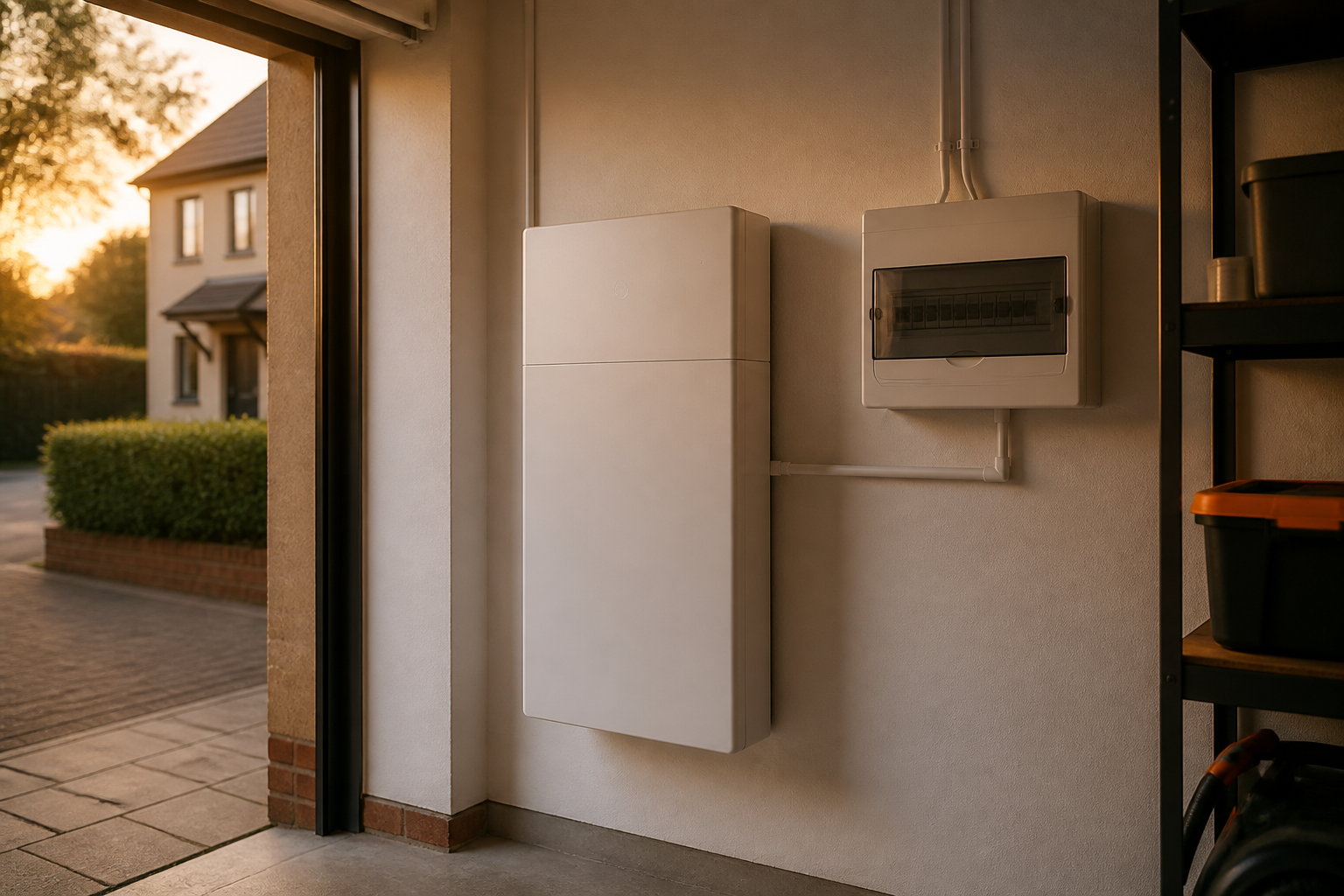
Hundreds of thousands of UK householders installed solar PV panels between 2010 and 2019 under the Feed-in Tariff (FiT) scheme or early self-consumption installations. Today, many of these systems generate substantial power during daylight hours, but much of that energy is exported back to the National Grid when householders are away from home. Adding a battery storage system to an existing solar array allows you to store excess daytime generation for use during peak evening hours, raising solar self-consumption from around 30 percent to over 70 percent, according to data from the Energy Saving Trust. However, retrofitting a battery to an established solar installation requires careful technical evaluation, electrical grid permissions and an understanding of how additions affect legacy generation tariffs.
What to check before adding a battery to an existing system
Before purchasing a battery retrofit, you must assess several technical and site-specific conditions to ensure your home is suitable:
- Existing inverter type and age: String inverters installed before 2018 may be nearing the end of their operational lifespan, which is typically 10 to 12 years. If your solar inverter is over eight years old, replacing it with a hybrid inverter during the battery installation can save on labour costs.
- Consumer unit capacity and location: Your main fuse box (consumer unit) must have adequate space for a new dedicated circuit breaker or switchgear. Modern installations require surge protection and proper earthing.
- Physical mounting location: Batteries require a dry, temperature-controlled environment or a suitable weatherproof enclosure rated to IP65. Cold conditions in uninsulated lofts can trigger automatic thermal throttling, reducing charging speeds.
- Distribution Network Operator (DNO) fuse rating: Most residential properties in England, Scotland and Wales have a main cut-out fuse rated between 60A and 100A. Adding a battery charger or combined inverter could exceed your supply threshold if running alongside electric vehicle chargers or heat pumps.
| Checkpoint | What to Inspect | Why It Matters |
|---|---|---|
| Existing Inverter | Age, model, location and DC cable route | Determines whether AC coupling or a hybrid inverter replacement is optimal. |
| Main Fuse Rating | 60A, 80A or 100A cut-out fuse on service head | Prevents main supply overload when battery charges alongside high-power appliances. |
| Battery Location | Loft, garage, utility room or external wall | Temperature stability affects lithium iron phosphate (LFP) efficiency and safety. |
| Cable Runs | Distance from main consumer unit to battery | Long AC or DC cable runs increase installation complexity and voltage drop. |
| FiT Status | Existing generation meter and scheme terms | Preserves legacy export incentive payments without regulatory penalties. |
AC coupling vs DC coupling for solar retrofits
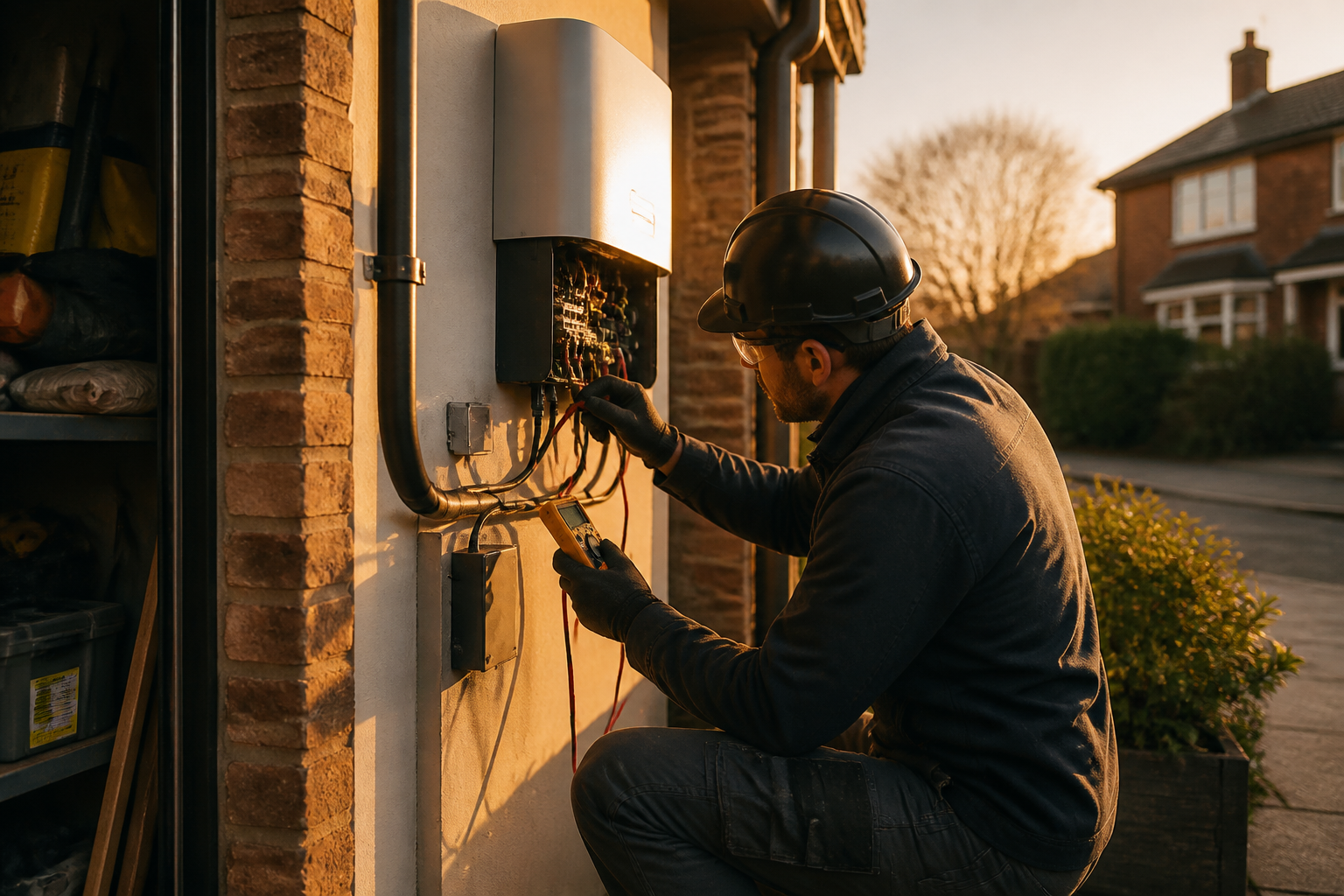
When retrofitting a battery to existing solar PV, you must choose between AC-coupled and DC-coupled architecture.
AC-coupled systems operate independently of your existing solar inverter. The solar panels continue feeding DC power into your original solar inverter, which converts it to AC electricity for your home. Excess AC power is then converted back to DC by a separate battery inverter to charge the storage pack. When you need power in the evening, the battery inverter converts the DC energy back into AC. While converting power twice introduces a small round-trip conversion loss of 8 to 12 percent according to the Microgeneration Certification Scheme (MCS), AC coupling requires no modifications to your existing solar wiring or solar inverter.
DC-coupled retrofits require removing your original solar inverter and replacing it with a modern hybrid inverter. The solar panels feed DC power directly into the hybrid inverter, which routes DC electricity straight into the battery pack without intermediate AC conversions. This achieves higher round-trip efficiency, often between 93 and 96 percent. However, replacing the inverter increases upfront equipment costs and requires rewiring the DC strings from the roof.
Navigating Feed-in Tariff rules and DNO approvals
If your home receives legacy Feed-in Tariff payments, retrofitting a battery requires strict compliance with Ofgem rules. Under FiT terms, generation payments are calculated based on total solar generation recorded by your physical FiT generation meter.
- Generation Meter Wiring: The battery must be installed downstream of the FiT generation meter. If power from the grid or battery flows backward through the generation meter, it could fraudulently inflate your generation readings.
- Deemed Export: Homes receiving deemed export payments, which assume 50 percent export, can add battery storage without forfeiting generation tariffs, provided the installation is declared to your FiT supplier.
- Grid Notifications (G98 vs G99): If your total combined inverter capacity (solar inverter plus battery inverter) remains under 16 Amps per phase, or 3.68kW, your installer can notify the Distribution Network Operator after installation under Engineering Recommendation G98. If the combined capacity exceeds 3.68kW, your installer must submit a G99 application and await DNO approval before commissioning.
Costs, installation steps and realistic timelines
The average cost of retrofitting a 5kWh usable capacity battery system to an existing solar array ranges between £2,500 and £4,500 including installation and VAT, while a 10kWh system typically costs between £4,500 and £7,000. Under UK tax rules, residential battery storage retrofits benefit from a 0% VAT rating until 31 March 2027.
The practical timeline for a battery retrofit installation follows five clear steps:
- Desktop and Site Assessment (1 to 2 weeks): The installer assesses your existing solar array, electrical board, cable pathways and DNO main fuse rating.
- DNO Permission (1 to 6 weeks): If your combined system capacity requires G99 approval, the installer submits plans to your regional DNO, such as National Grid Electricity Distribution or SP Energy Networks.
- Equipment Ordering and Pre-wire (1 week): The installer prepares the electrical circuit, installs isolation switches and sets up mounting backplates.
- Physical Installation and Commissioning (1 day): Technicians mount the battery unit, connect the battery inverter or hybrid controller, fit current transformer (CT) clamps to monitor household load, and configure grid export limits.
- Handover and Compliance Documentation (1 to 2 weeks): You receive your MCS certificate, electrical installation certificate (EIC), battery warranty papers and DNO notification confirmation.
Accredited installers and compliance standards
To ensure system safety, grid compliance and eligibility for smart energy export tariffs, your installation must meet recognized UK standards:
- MCS Certification: Choose an installer certified under the Microgeneration Certification Scheme for battery storage (MIS 3012). MCS certification is required by major UK energy suppliers to register for Smart Export Guarantee (SEG) tariffs.
- PAS 63100 Compliance: Ensure your battery installation complies with PAS 63100, the UK code of practice for electrical energy storage systems in domestic premises, which governs fire separation, clearance distances and location limits.
- RECC or HIES Registration: Confirm your installer belongs to a Consumer Code Approval Scheme such as the Renewable Energy Consumer Code (RECC) or Home Insulation & Energy Systems Contractors Scheme (HIES), providing deposit protection and independent dispute resolution.
- NICEIC or NAPIT Registration: The electrician connecting your system to your main consumer unit should hold competent person scheme accreditation under NICEIC or NAPIT to certify Part P building regulations compliance.
What this means for you
Retrofitting battery storage to an existing solar installation is one of the most effective ways to capture unused renewable generation, reduce electricity bills and increase your self-sufficiency. By selecting an MCS-accredited installer, choosing the right coupling architecture for your inverter age, and securing necessary DNO approvals, you can safely extend the capability of your solar setup. Employees looking to lower household energy costs can also access member pricing on solar and battery installations through the Net Zero Home Scheme.
Frequently asked questions
Will adding a battery affect my existing Feed-in Tariff payments?
No, as long as the battery is installed downstream of your existing FiT generation meter. This ensures that the meter only registers generation coming directly from your solar panels, preserving your generation tariff payments without conflict.
Should I choose AC-coupled or DC-coupled battery storage?
If your existing solar inverter is less than five years old and working efficiently, an AC-coupled battery is usually faster and more cost-effective to install. If your solar inverter is over eight years old or approaching the end of its lifespan, replacing it with a DC-coupled hybrid inverter is often a smarter long-term investment.
Do I need planning permission to add a home battery?
In most UK residential properties, installing a home battery storage system inside a garage, utility room or on an external wall falls under Permitted Development rights. However, if your home is a listed building or located within a Conservation Area, you should check with your local planning authority before installation.
Sources
- MCS MIS 3012 Battery Storage Standard, Microgeneration Certification Scheme
- Energy Saving Trust Guide to Solar and Storage, Energy Saving Trust
- Ofgem Feed-in Tariffs Guidance, Ofgem