Report Urges £1bn Investment in UK Heat Networks
Industry groups urge the UK government to commit £1bn to heat networks to unlock £4bn in investment and supply one fifth of UK heating demand.
- Written by
- Net Zero Home Scheme editorial team
- Last updated
- Topic
- heat pumps, policy, energy efficiency
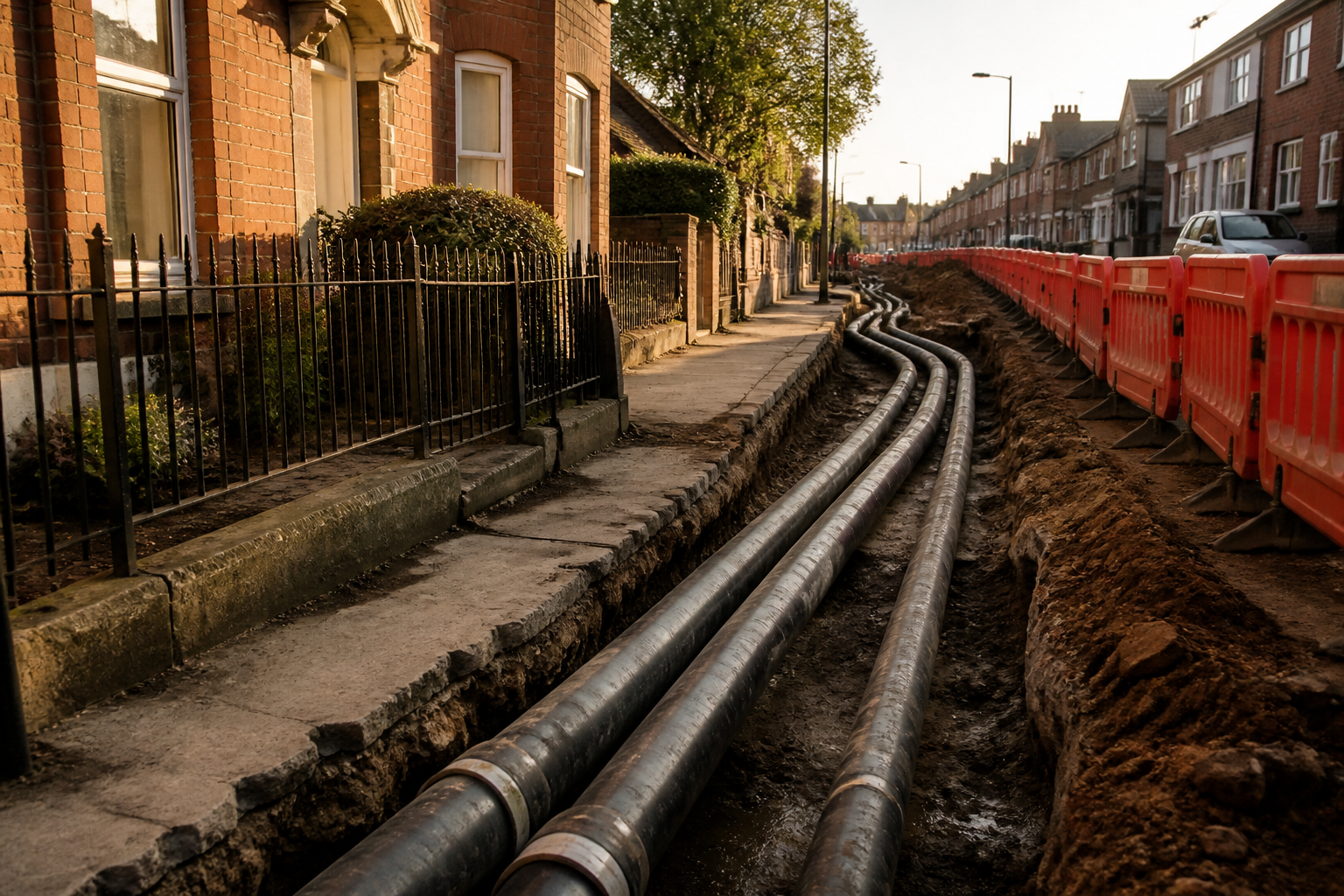
On 21 August 2026, energy news outlet edie reported that heat industry advocates have called on the UK government to invest £1 billion in national heat network infrastructure. The proposal argues that public seed capital could crowd in £4 billion of private sector investment, expanding district heating to cover one fifth of total UK building heat demand.
Heat networks, also known as district heating, supply hot water and space heating to multiple buildings from a central thermal source through insulated underground pipes. While common in Northern and Eastern Europe, district heating currently serves under 3 percent of UK homes. The proposal highlighted by edie on 21 August 2026 aims to accelerate large-scale deployment in dense urban areas where individual heat pump retrofits can face space and structural constraints.
How district heating works for connected properties
Instead of maintaining an individual gas boiler or external heat pump unit, a property connected to a heat network receives heat via a Hydraulic Interface Unit (HIU) installed inside the home. The HIU functions similarly to a compact combi boiler, transferring thermal energy from the central pipe circuit into the building hot water and central heating systems.
Central heat sources for modern lower-temperature networks typically include large water-source or air-source commercial heat pumps, industrial waste heat recovery, data centre waste heat, or geothermal extraction. Because the central plant operates at scale, advocates argue it can achieve higher seasonal efficiency than smaller domestic units while reducing grid infrastructure pressure in high-density streets.
What the numbers say

The figures released in the proposal and reported by edie on 21 August 2026 set out specific capital targets and projected system coverage across the domestic heating sector.
| Metric | Published Value | Source and Date | Practical Context |
|---|---|---|---|
| Proposed Public Capital | £1 billion | edie, 21 August 2026 | Direct government grant or infrastructure seed funding |
| Target Private Co-Investment | £4 billion | edie, 21 August 2026 | Private capital expected to be unlocked by public funding |
| Projected Heat Demand Share | 20 percent | edie, 21 August 2026 | Target proportion of UK heating delivered by heat networks |
| Average Household Connection Cost | Not reported | edie, 21 August 2026 | Capital fee per consumer connection remains unspecified |
| Projected Consumer Tariff Rates | Not reported | edie, 21 August 2026 | Long-term kWh pricing mechanisms are not detailed |
While the headline funding target of £1 billion is explicit, several practical details remain unconfirmed. The reported details do not outline how individual household connection costs would be distributed between developers, local authorities, and residents. Furthermore, the report does not state consumer heat tariff formulas or statutory protection terms for households connected to monopolistic local network operators.
Capital requirements and structural constraints
Expanding district heating requires extensive civil engineering work, including digging up streets to lay insulated distribution mains. In existing suburban housing estates with low property density, the cost of pipe trenching per home can exceed the installation cost of individual air source heat pumps. Consequently, industry proposals focus primarily on high-density city centres, new-build developments, and multi-occupancy flat blocks where pipe runs are shorter relative to heat demand.
For existing homeowners outside designated heat network zones, individual domestic technologies such as rooftop solar PV, standalone heat pumps, and home battery storage remain the primary path to lowering grid energy consumption.
Frequently asked questions
Can any householder sign up to connect to a heat network?
No. Unlike electricity or mains gas, heat network availability depends entirely on physical underground infrastructure in your immediate street. Unless a local authority or energy developer constructs a network main past your boundary, individual connection is not possible. Most UK single-family suburban homes will remain reliant on individual heating solutions.
How are consumer prices regulated on UK heat networks?
Historically, heat networks operated outside standard Ofgem price caps. However, regulation is transitioning to Ofgem oversight under the Energy Security Act framework to ensure consumers receive fair pricing, reliable service, and transparent billing. Because households connected to a network cannot switch suppliers, regulatory safeguards focus on benchmarking heat tariffs against alternative heating options.
Does a heat network connection require changes to indoor radiators?
Modern low-temperature heat networks operate at flow temperatures between 50°C and 55°C to maximize heat source efficiency. If a older home with small radiators connects to a modern network, existing radiators may need to be upgraded or supplemented with fan convector units to maintain comfortable room temperatures during peak winter weather.
What this means for your home
If you live in a detached, semi-detached, or terraced home in a low-density residential neighborhood, this industry proposal does not alter your immediate home heating strategy. District heat networks are unlikely to reach low-density suburban streets in the near term due to the high civil engineering costs of running underground pipework. Waiting for a potential future network connection is generally impractical if your current boiler is aging or inefficient.
For householders seeking to reduce energy bills today, on-site home upgrades deliver verifiable, immediate reductions in grid import:
- Individual heat pumps: Air source heat pumps provide independent room heating and hot water control without reliance on a single municipal supplier.
- Solar PV generation: Generating solar electricity on your roof directly offsets daytime grid usage and powers domestic heating appliances.
- Battery storage: Storing off-peak grid electricity or surplus solar output allows you to run home heating during expensive peak tariff hours.
If you reside in a leasehold flat or a planned urban regeneration zone, you should check with your local council or freeholder to see if a district heat network zone is designated for your area before making major individual heating investments.
What this means for employers
Rising national debate around energy costs and decarbonisation proposals continues to keep domestic utility bills high on the agenda for UK employees. As staff evaluate how national energy policy affects their personal finances, employers face growing interest in concrete, workplace-supported sustainability initiatives that deliver tangible household savings.
Providing practical home energy benefits helps organisations support staff resilience without introducing ongoing administrative complexity. Through the Net Zero Home Scheme, delivered by Net Zero Benefits alongside The Electric Car Scheme, employers can give staff access to member pricing on solar PV, heat pumps, battery storage, and plug-in solar installed by accredited engineers across England, Scotland, and Wales. The scheme is free for employers to implement, involves no salary sacrifice or payroll deductions, and provides employees with a direct route to lower their home running costs.