Sizing Radiators for Low Temperature Heating Systems
Lowering flow temperatures boosts heat pump efficiency, but requires properly sized radiators to keep your home warm. Here is the physics, calculations, and trade-offs explained.
- Written by
- Net Zero Home Scheme editorial team
- Last updated
- Topic
- heat pumps, energy efficiency, mcs
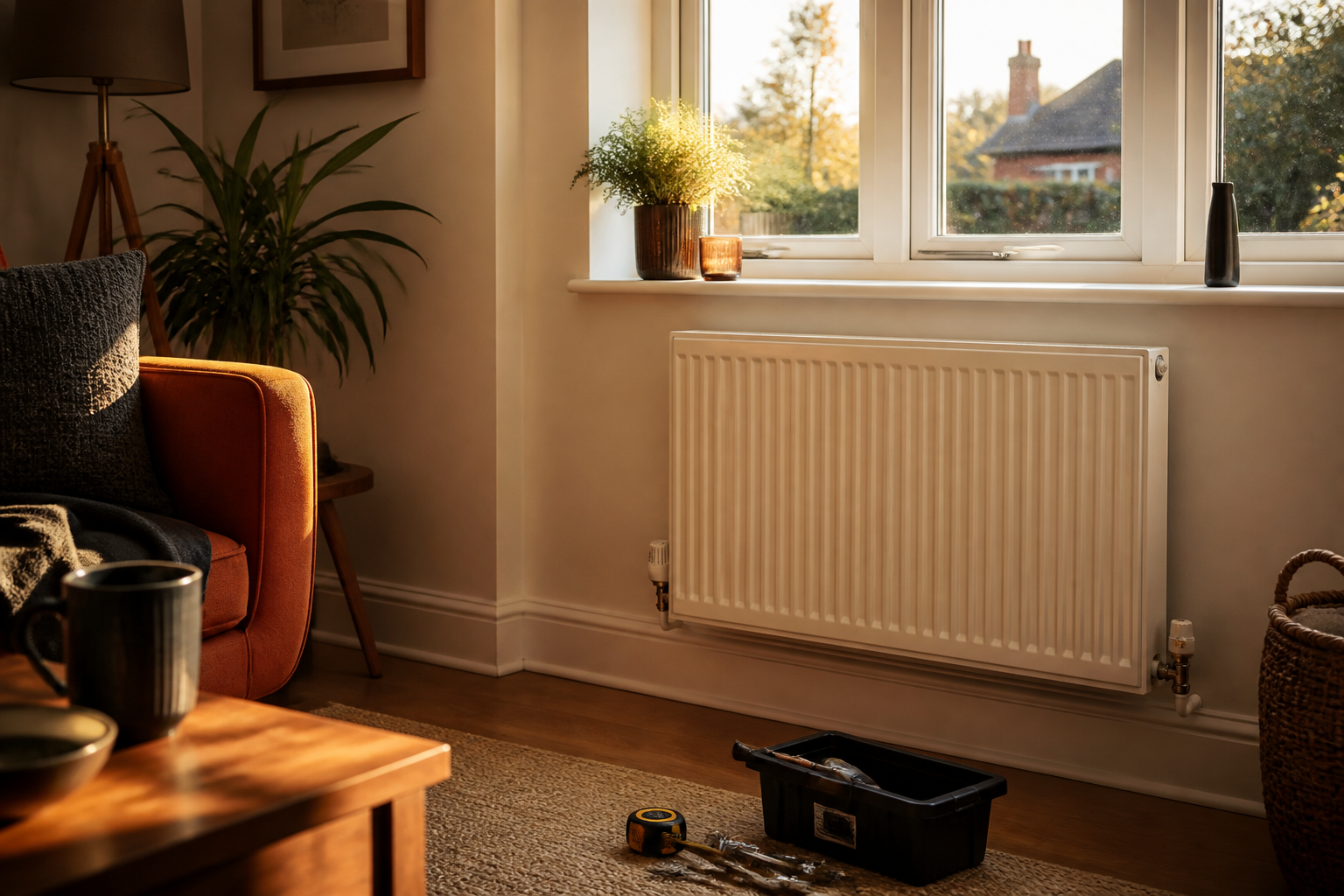
Transitioning a UK home from a traditional fossil fuel boiler to an air source heat pump or a high-efficiency condensing boiler requires a fundamental change in how heat is delivered to your living spaces. Traditional gas and oil boilers typically operate at high flow temperatures, delivering water to radiators at roughly 65°C to 75°C. Heat pumps, by contrast, achieve their maximum efficiency when supplying water at lower flow temperatures, typically between 35°C and 45°C.
Because the rate of heat output from a radiator depends directly on the temperature difference between the radiator surface and the surrounding air, dropping the flow temperature drastically reduces the thermal power that an existing radiator can emit. Understanding the physics of radiator output, the mathematical relationship behind temperature differentials, and the practical spatial trade-offs is essential when designing a low-carbon heating retrofit.
The physics of heat emitters and Delta T
The heat output of any hydronic radiator depends on convection and thermal radiation. The governing factor for radiator output is Delta T (written as ΔT), which represents the temperature difference between the average water temperature inside the radiator and the ambient air temperature of the room.
Under British and European standard BS EN 442, radiators are tested and rated at a standard testing condition known as ΔT50. This assumes an inlet water temperature of 75°C, an outlet return temperature of 65°C (giving a mean water temperature of 70°C), and a room temperature of 20°C. Subtracting the 20°C room temperature from the 70°C mean water temperature gives a ΔT of 50°C.
When you operate a heat pump at a low flow temperature, such as 45°C with a 40°C return, the mean water temperature is 42.5°C. In a room maintained at 20°C, the operating Delta T drops to ΔT22.5. Because heat output does not scale linearly with temperature difference, a radiator running at ΔT22.5 delivers less than one-third of the heat output it produces at ΔT50.
According to technical design guidance from the Chartered Institution of Building Services Engineers (CIBSE), the heat output of a radiator at a non-standard Delta T is calculated using an exponent formula:
Output = Standard Output at ΔT50 × ( Operating ΔT / 50 ) ^ n
For standard steel panel radiators, the exponent n is typically taken as 1.3. If a room requires 1,000 Watts of thermal energy to offset its heat loss on a cold winter day, a radiator rated at 1,000 Watts under traditional ΔT50 conditions will only yield approximately 340 Watts when supplied with 45°C water. To meet the room's peak heat loss without raising the flow temperature, the radiator surface area must be expanded substantially.
Why lower flow temperatures drive heat pump performance
The driving motivation for sizing radiators to work at lower flow temperatures is efficiency, measured by the Seasonal Coefficient of Performance (SCOP). The SCOP describes how many units of heat energy a heat pump delivers for every unit of electricity it consumes over a full heating season.
The thermodynamic efficiency of a refrigeration cycle is limited by the temperature lift, which is the difference between the outdoor ambient air temperature and the flow temperature required by the central heating circuit. A smaller lift requires less work from the compressor motor.
Data compiled by the Energy Saving Trust demonstrates that reducing a heat pump's design flow temperature from 55°C down to 35°C can improve system efficiency by up to 25%. A system operating at 35°C flow temperature might achieve an SCOP of 3.8 to 4.2, meaning 1 kWh of electricity generates 3.8 to 4.2 kWh of heat. Running the same heat pump at 55°C flow temperature reduces the SCOP to roughly 2.8 to 3.0, raising running costs proportionately.
Under the standards set by the Microgeneration Certification Scheme (MCS), specifically standard MIS 3005-D for heat pump system design, installers are required to calculate peak space heating loss room by room and select emitters capable of meeting that loss at the lowest practical design flow temperature.
Comparing radiator types and spatial impact
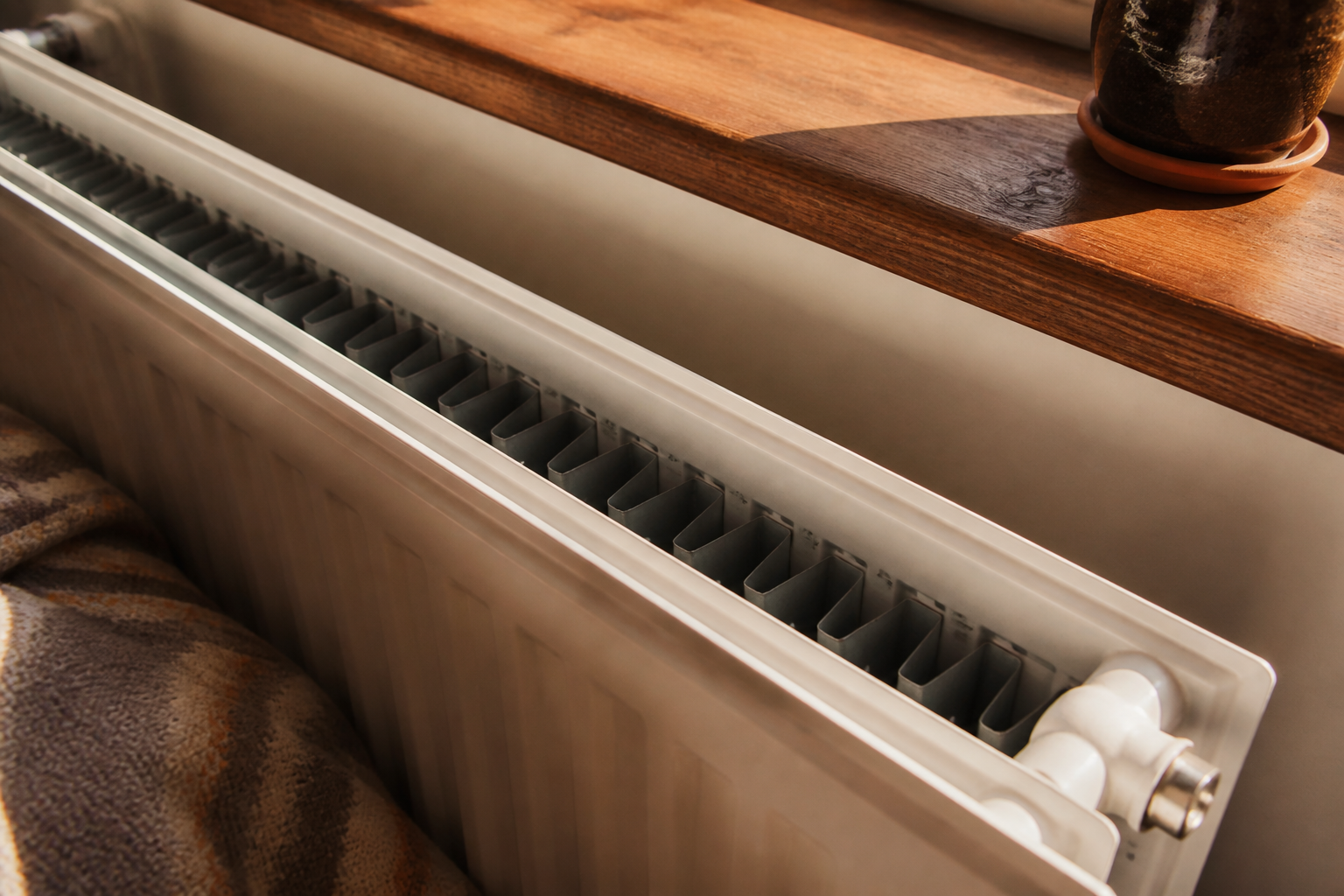
When increasing radiator capacity to accommodate lower flow temperatures, homeowners do not always need to double the physical width or height of the unit on the wall. Radiators are available in different depth configurations that add internal surface area and convective fins without taking up extra wall length.
- Type 11 (K1): Single panel with one set of convective fins.
- Type 21 (P+): Double panel with one set of convective fins.
- Type 22 (K2): Double panel with two sets of convective fins.
- Type 33 (K3): Triple panel with three sets of convective fins.
Replacing a thin Type 11 radiator with a Type 22 or Type 33 unit of the same length and height can double or triple the available surface area, helping offset the lower operating Delta T within the existing wall footprint.
| Radiator Type | Depth (mm) | Heat Output at ΔT50 (Watts)* | Heat Output at ΔT25 (Watts)* | Relative Output Factor |
|---|---|---|---|---|
| Type 11 (Single Panel, Single Convector) | 50 - 65 | 1,000 | 350 | 35% |
| Type 21 (Double Panel, Single Convector) | 70 - 90 | 1,350 | 470 | 35% |
| Type 22 (Double Panel, Double Convector) | 100 - 110 | 1,800 | 630 | 35% |
| Type 33 (Triple Panel, Triple Convector) | 160 - 170 | 2,400 | 840 | 35% |
*Outputs based on a standard 1000mm x 600mm panel size for comparative illustration, derived from manufacturer testing standards under BS EN 442.
Trade-offs, pipework limitations, and counter-arguments
While sizing radiators for low flow temperatures optimizes efficiency, there are real trade-offs, spatial restrictions, and financial costs that must be considered.
Wall space and room aesthetics
In smaller rooms, particularly bedrooms or kitchens with fitted furniture, installing a larger or deeper radiator may not be physically possible. A Type 33 radiator projects up to 170mm from the wall surface, which can interfere with door openings, furniture placement, or walkway space.
Pipework sizing and hydraulic flow
Lower flow temperatures mean water carries less thermal energy per litre. To deliver the same total amount of heat energy to a room, a low-temperature system must circulate a larger volume of water every minute. According to the CIBSE Domestic Heating Design Guide, this higher mass flow rate can cause friction noise or excessive pressure drops if existing pipework is too narrow.
Many mid-20th-century UK homes feature 10mm or 8mm microbore copper pipework. Running high flow rates through microbore pipework can restrict system performance or require high circulator pump speeds that consume extra electricity. In such cases, replacing sections of sub-floor pipework with 15mm or 22mm copper pipe is necessary, adding installation labor and floorboard disruption.
Initial capital cost vs operational savings
Replacing eight to twelve radiators across a house increases the upfront hardware and installation costs of a heat pump retrofit. A modern steel panel radiator costs between £80 and £250 depending on size and type, plus plumber labor charges. However, operating a heat pump at 45°C rather than 55°C lowers electricity consumption over the 15 to 20 year lifespan of the appliance, usually offsetting the initial emitter costs within several heating seasons.
What this means for you
If you are planning to replace a fossil fuel boiler with a low-carbon heating system, radiator design should be evaluated early in the process.
- Commission a room-by-room heat loss calculation in accordance with MCS MIS 3005-D standards rather than relying on whole-house estimates or rule-of-thumb rules.
- Evaluate existing radiator dimensions and types to identify where upgrading to deeper Type 22 or Type 33 units can boost heat output without increasing wall length.
- Ask your installer to check existing pipework diameters, specifically checking whether microbore pipes are present that might constrain circulation rates.
- Balance initial hardware costs against long-term electricity consumption, prioritizing lower flow temperatures (45°C or lower) wherever wall space permits.
If you are considering upgrading your home heating, the Net Zero Home Scheme offers UK employees access to accredited installer networks and member pricing on heat pumps and complementary clean energy technology.
Frequently asked questions
Can I keep my existing radiators when switching to a heat pump?
Yes, in many cases you can keep a portion of your existing radiators, provided they are already oversized relative to the heat loss of those specific rooms. Homes that have been insulated since their heating system was original installed often have excess radiator capacity. However, rooms with high heat loss or small existing radiators will usually require upgraded, larger units to heat the room effectively at lower flow temperatures.
Will low-temperature radiators make my house feel colder?
No, a properly designed low-temperature heating system will maintain the exact same room temperature as a high-temperature boiler system. The difference is in how the heat is delivered. Instead of brief bursts of intense heat from hot 75°C radiators, low-temperature systems run for longer periods, providing gentle, constant warmth that keeps room temperatures continuous and steady.
Do I need underfloor heating to run a heat pump efficiently?
Underfloor heating is ideal for heat pumps because its large surface area allows for very low flow temperatures of 35°C or below. However, underfloor heating is not strictly required. Properly sized steel panel radiators operating at 40°C to 45°C flow temperatures can achieve high heat pump efficiency without the expense and floor disruption of laying underfloor pipework loops.
Sources
- MCS MIS 3005-D Heat Pump Standard, Microgeneration Certification Scheme
- Domestic Heating Design Guide, Chartered Institution of Building Services Engineers
- BS EN 442 Radiators and Convectors Standard, British Standards Institution
- Heat Pump Efficiency and Flow Temperatures, Energy Saving Trust