PAS 63100 Battery Safety Rules for UK Home Storage
Understand PAS 63100 safety standards for domestic battery storage, covering location rules, clearance distances, and fire alarm requirements.
- Written by
- Net Zero Home Scheme editorial team
- Last updated
- Topic
- battery storage, regulation, home energy
As residential battery storage expands rapidly across Great Britain, safety standards have evolved to match the physical reality of home energy storage. The British Standards Institution published PAS 63100, a dedicated code of practice covering the site selection, fire safety, and electrical installation of battery energy storage systems in residential accommodation. Developed alongside the Institution of Engineering and Technology, the Health and Safety Executive, and the Renewable Energy Consumer Code, PAS 63100 establishes clear operational parameters for installers and property owners.
Lithium-ion batteries store substantial electrical energy in a compact footprint, usually ranging between 3 kWh and 15 kWh for domestic systems. While modern battery management systems monitor cell voltage, temperature, and current to prevent electrical faults, thermal runaway remains the critical risk. Thermal runaway occurs when an internal fault or extreme heat triggers self-sustaining chemical reactions, releasing flammable gases and intense heat. PAS 63100 addresses this risk by defining physical separation distances, fire compartmentation standards, and detection requirements.
Location rules for domestic battery storage
PAS 63100 classifies where home batteries can and cannot be situated based on fire risk to occupants and emergency access. The primary objective is ensuring that a thermal event does not trap householders or prevent safe evacuation along protected escape routes.
Prohibited installation spaces
Under PAS 63100 guidance, battery units must not be installed in primary escape routes, including hallway corridors, stairwells, or landing spaces that serve as the main exit path from a property. Sleeping accommodation is strictly off-limits, meaning batteries cannot be fitted inside bedrooms or emergency escape rooms.
Lofts and attic spaces are heavily restricted. While early battery installations frequently placed units in lofts to save ground-floor living space, PAS 63100 advises against loft locations unless specific design criteria are met. Loft spaces present structural and operational hazards, including elevated summer temperatures that degrade cell chemistry, difficult access for emergency services, and structural timber framing that can accelerate flame spread during a failure.
Permitted and recommended locations
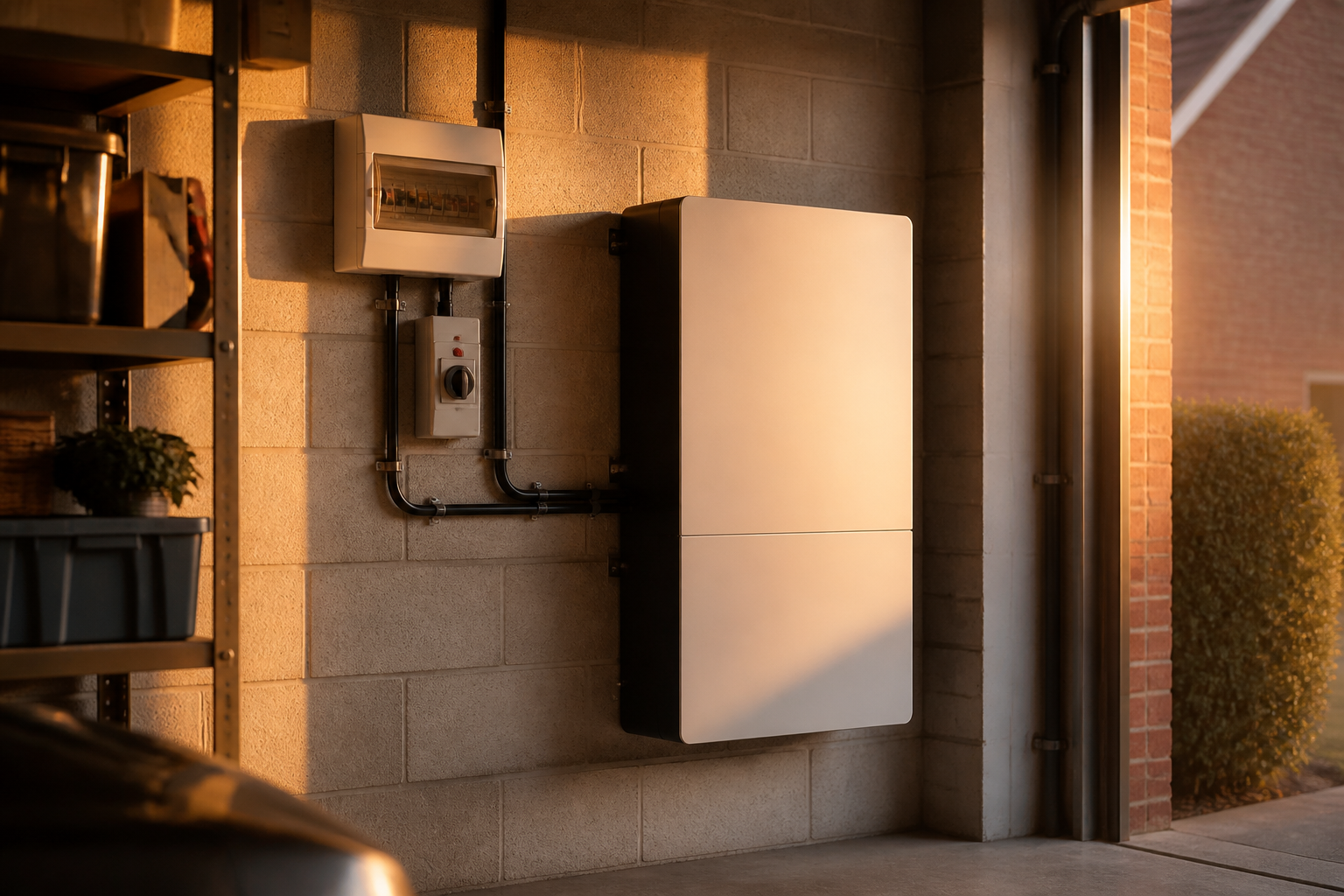
The standard identifies dedicated, non-habitable areas as the safest locations for domestic batteries. Attached or detached garages, dedicated utility rooms, and outdoor ground-level walls are preferred locations.
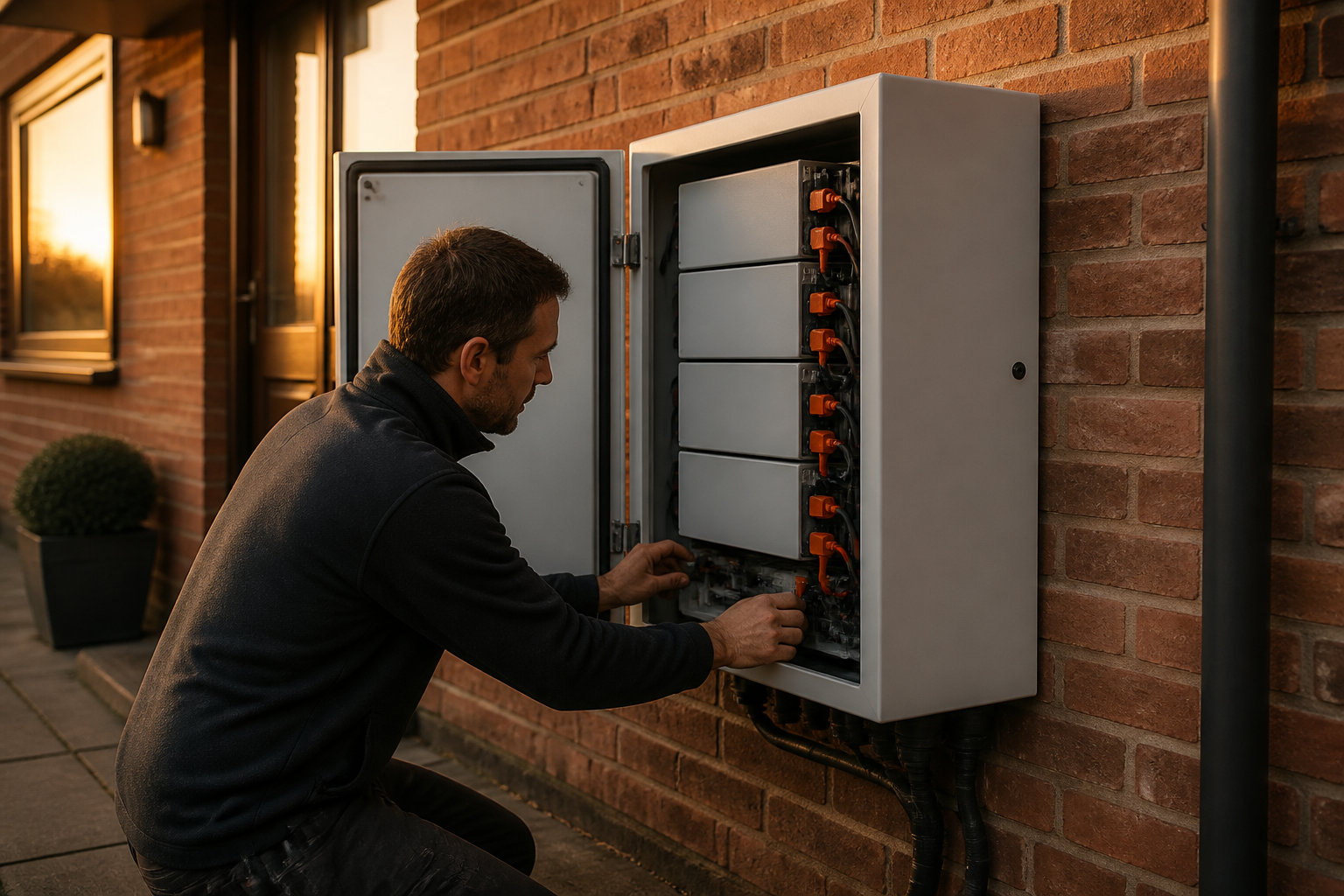
Outdoor wall-mounted installations are increasingly common across England, Scotland, and Wales. When installed externally, the battery cabinet must carry a minimum ingress protection rating of IP65 to resist driving rain, dust, and frost. The unit must be positioned clear of ground moisture, at least 300 mm above finished ground level, and protected from direct continuous sunlight where summer heat could trigger thermal throttling.
| Location Type | PAS 63100 Suitability | Key Requirements |
|---|---|---|
| Garages (attached or detached) | Recommended | EI 30 fire separation from main dwelling, linked heat detection |
| External brick wall | Recommended | IP65 protection, 300 mm ground clearance, 1,000 mm from doors or windows |
| Utility rooms | Permitted with conditions | Non-combustible backing, linked heat alarm, non-escape path |
| Lofts and attics | Restricted or avoided | Timber boarding, permanent stair access, thermal monitoring required |
| Bedrooms and stair halls | Prohibited | Strictly forbidden under fire safety guidance |
Clearances, fire separation, and alarm requirements
Physical spacing around the battery enclosure is critical for heat dissipation during normal operation and containment in an emergency. PAS 63100 defines precise clearance margins between the battery casing and surrounding building features.
Installers must maintain a minimum clear distance of 1,000 mm between a battery enclosure and any operable door, window, or ventilation intake. This spatial boundary prevents toxic smoke or vented gases from entering habitable rooms if a thermal event occurs. In addition, batteries must be kept clear of direct electrical meter tails and gas pipework, keeping a minimum distance of 500 mm from domestic gas supply lines.
Where a battery is mounted indoors, the wall surface behind the unit must consist of non-combustible material, such as brick, concrete, or fire-rated plasterboard rated to Class A1 or A2 standards. Timber stud partitions or decorative wood cladding must be protected by a non-combustible backing board extending at least 200 mm beyond the perimeter of the battery unit.
Fire detection is another mandatory element under the standard. Property owners must ensure that a heat detector, rather than a standard optical smoke detector, is installed in the room housing the battery system. Optical smoke alarms in unconditioned spaces like garages or utility rooms are prone to false alarms from dust or humidity, whereas interlinked heat detectors provide reliable early warning. The heat detector must be hardwired or radio-linked to the main dwelling fire alarm system according to BS 5839-6 standards, ensuring that an alarm in an external garage triggers sounding devices throughout the house.
Electrical integration and installer compliance
PAS 63100 operates alongside existing UK electrical and microgeneration standards. Installers must comply with BS 7671 Wiring Regulations, including requirements for protective earthing, residual current devices, and surge protection devices.
For grid-connected home batteries, installations must meet MCS standard MIS 3012, which governs electrical energy storage systems. MIS 3012 requires installers to conduct a structural assessment of mounting surfaces, verify grid connection permissions under Distribution Network Operator rules such as G98 or G99 notifications, and fit a clearly labelled DC isolator adjacent to the inverter or battery unit.
Emergency isolation switches must be installed in an easily accessible location. In the event of a fault, emergency services or householders must be able to disconnect the battery from the home grid safely.
What this means for you
If you are planning to add battery storage to your home, safety standard compliance starts during the initial site survey. Working with a qualified installer who adheres to PAS 63100 and MCS standards ensures your system is safe, insurable, and compliant with building regulations.
- Assess your proposed location: Identify whether your intended battery spot is a garage, utility room, or external wall. Avoid hallways, stairwells, and bedrooms.
- Check environmental conditions: Ensure the space stays within the manufacturer operating temperature range, typically between minus 10 degrees Celsius and 45 degrees Celsius.
- Verify fire alarm integration: Confirm that your installer includes an interlinked heat detector in the battery room connected to your main fire alarm setup.
- Confirm installer accreditation: Check that your installer holds MCS accreditation for battery storage under MIS 3012 and is registered with a competent person scheme such as NICEIC, NAPIT, or TrustMark.
- Review home insurance terms: Inform your buildings insurance provider of the battery installation, providing the installer MCS certificate and compliance documentation.
If you are evaluating home green energy upgrades, the Net Zero Home Scheme provides employees of participating UK organisations with access to accredited installers offering member pricing on solar PV, heat pumps, and battery storage systems.
Frequently asked questions
Can I install a home battery in my loft under PAS 63100?
While PAS 63100 does not issue an absolute statutory prohibition, it strongly discourages installing battery storage systems in lofts. Lofts suffer from extreme seasonal temperature variations, limited emergency access, and combustible wooden roof trusses. Most accredited installers will advise against loft mounting and recommend a garage or external wall instead.
Do I need to upgrade my fire alarms when fitting a home battery?
Yes. PAS 63100 requires a heat detector to be installed in the space where the battery unit is located. This heat alarm must be interlinked with your property main fire detection system under BS 5839-6 guidelines so that all alarms sound simultaneously if a thermal issue occurs.
Can battery storage systems be installed on external walls?
Yes, external wall installation is common and recommended under PAS 63100, provided the battery casing is rated to at least IP65 for weatherproofing. The battery must be mounted on a solid brick or masonry wall at least 300 mm above ground level and 1,000 mm away from windows, doors, and air vents.
Sources
- PAS 63100: Installation of Battery Energy Storage Systems in Residential Accommodation, British Standards Institution
- MIS 3012: Requirements for MCS Contractors Undertaking the Installation of Battery Energy Storage Systems, Microgeneration Certification Scheme